

Options contracts in practice
Overview
An options contract is a standardised agreement listed on an exchange. It gives the buyer a right and places an obligation on the seller over a defined underlying asset or reference value, at a defined strike price, on or before a defined expiry, for a premium paid up front.
For listed options, key contract terms such as strike, expiry, exercise style, settlement style and contract size are set by the exchange and cleared through a central clearing house. In practice, four terms do most of the mechanical work: premium, strike price, expiry and contract multiplier.
The premium is the price paid by the buyer and received by the seller. The strike price is the price at which the contract is exercised. Expiry is the last date on which the option exists or may be exercised, depending on style. The contract multiplier turns the quoted option price into the actual money amount per contract and also converts intrinsic value into the cash or delivery amount.
Two value concepts matter throughout the contract lifecycle. Intrinsic value is the amount an option is in the money, if any. Extrinsic value, often called time value, is the part of the premium above intrinsic value and reflects time to expiry, volatility and other pricing inputs. If an option is out of the money, its intrinsic value is zero and its premium is entirely extrinsic value.
One of the most important practical distinctions is between physically settled and cash-settled contracts. A physically settled equity option can create or remove an actual share position after exercise or assignment. A cash-settled index option instead creates a cash debit or credit based on the difference between strike and settlement value. Options on futures are another layer again because exercise or assignment usually creates a futures position unless the specific product is financially settled.
The most useful way to understand options contracts is to follow the lifecycle as it appears in an account: what is bought, what is paid, what can happen before expiry, what happens at expiry, and how the final outcome changes with settlement style.
Core definitions
Step by step walkthrough
The decision loop
A practical options process does not start with prediction. It starts with contract mechanics. Before a position is entered or held into expiry, the contract terms and likely account outcome need to be checked in order.
The core loop is straightforward: identify the contract terms, check whether the market is liquid enough to trade, understand the timing and expiry mechanics, confirm the settlement implications, and decide in advance what end state is acceptable.
Worked examples
The examples below show how the same basic contract logic leads to different account outcomes depending on settlement style.
The arithmetic is simple on purpose. The aim is to show what the multiplier does, what expiry changes, and why the final result is not the same for equity options and index options.
Assume the underlying share price at trade date is 52. The contract chosen is 1 ABC June 50 call. It is American style, physically settled, with a multiplier of 100 shares, and the premium paid is 3.20.
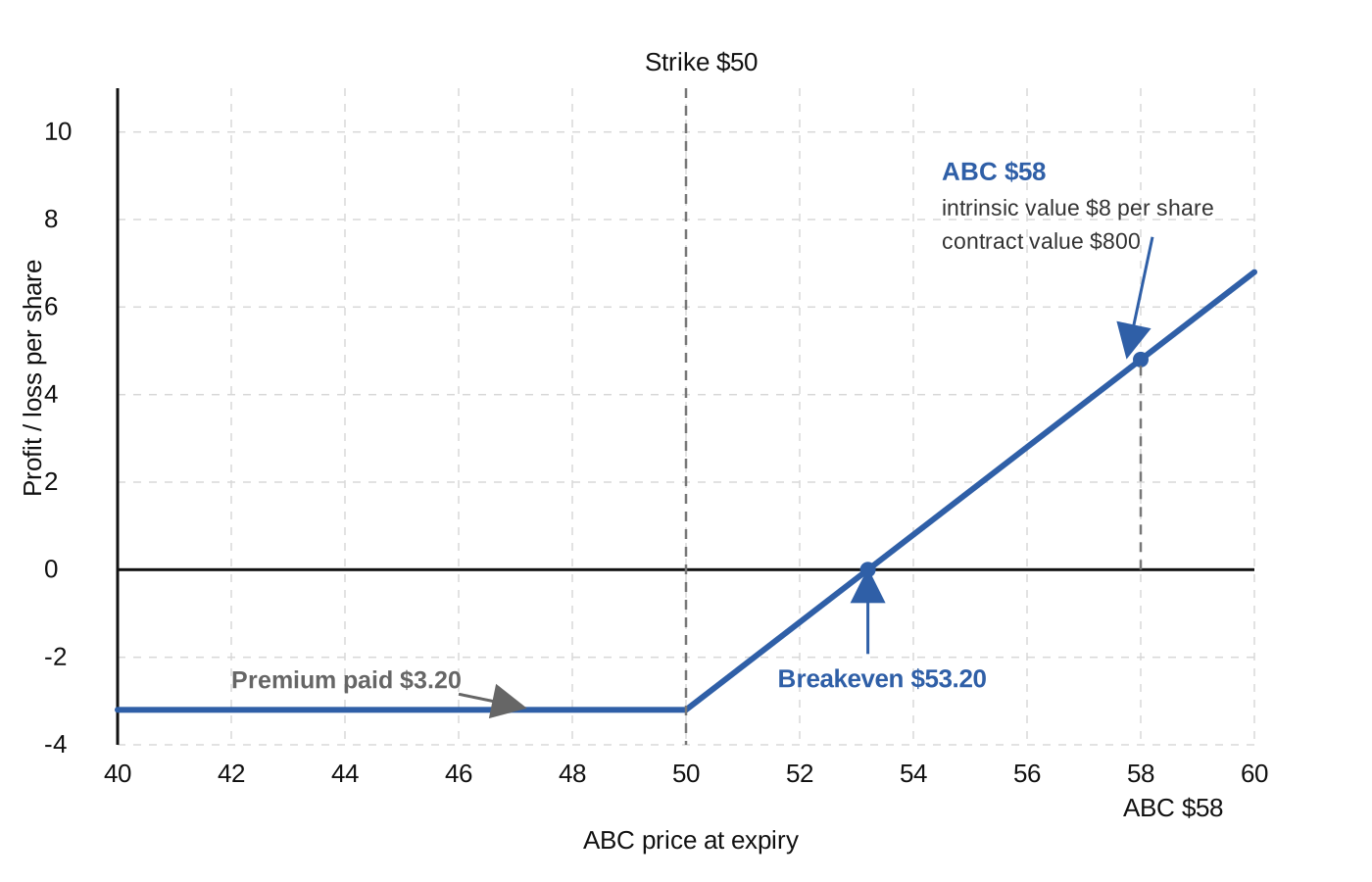
At entry, the quoted premium of 3.20 becomes an actual premium paid of 320 once multiplied by 100, before fees. The buyer now has the right to buy 100 ABC shares at 50 on any business day up to expiry. The seller has the obligation if assigned.
If ABC is 58 at expiry, intrinsic value is 8 per share. Contract intrinsic value is therefore 800. If exercised, the long holder buys 100 shares for 5,000 and those shares are worth 5,800 at the market price. Gross exercise value is 800, and net profit relative to the 320 premium paid is 480 before costs.
If the short is assigned in that outcome, the account must deliver 100 shares and receives 5,000 cash at the strike. If the short holder does not already own the shares, the broker must source or purchase them for delivery, creating the usual short-call delivery obligation.
If ABC is 47 at expiry, the call is out of the money and intrinsic value is zero. If it expires unexercised, the option lapses and ceases to exist. The long holder loses the 320 premium paid, and the short holder keeps the 320 premium received before costs and financing.
This example shows two practical points. First, the multiplier turns a small-looking quote into a real cash amount. Second, physical settlement means the end state can be an actual 100-share delivery outcome rather than only a paper profit or loss.
| Measure | Basis | Value |
|---|---|---|
| Underlying at trade date | ABC | $52.00 |
| Premium per share | Stated | $3.20 |
| Premium paid | 3.20 times 100 | $320.00 |
| Close at 58 | In the money | $58.00 |
| Intrinsic value per share | 58 minus 50 | $8.00 |
| Contract intrinsic value | 8 times 100 | $800.00 |
| Strike cost | 100 shares at 50 | $5,000.00 |
| Share value at 58 | 100 shares | $5,800.00 |
| Net profit versus premium | 800 minus 320 | $480.00 |
| Close at 47 | Out of the money | $47.00 |
| Long premium loss at 47 | Stated | $320.00 |
| Short premium kept at 47 | Stated | $320.00 |
| Net profit versus premium | $480.00 | |
Assume a cash-settled index call with a strike of 4500, a settlement value at expiry of 4540, a multiplier of 100, a premium paid of 18.00, and European style exercise.
At entry, the premium paid is 1,800 because 18.00 is multiplied by 100. The contract references an index value and settles in cash. It does not represent shares of an ETF.
At expiry, the in-the-money amount is 40 index points, calculated as 4540 minus 4500. The cash settlement amount is therefore 4,000 because 40 is multiplied by 100.
Instead of receiving securities, the long account is credited 4,000 cash and the short account is debited 4,000 cash, subject to clearing and broker processing. Net of premium, the long holder’s gross result is 2,200 before costs. No share position is created and no stock delivery is required.
What changes from the equity example is the end state. There is no need to fund the purchase of underlying shares at the strike and no residual equity position after exercise. The key planning issue becomes the product’s settlement convention because some index-related contracts use special opening values rather than a simple closing print.
| Measure | Basis | Value |
|---|---|---|
| Strike | Stated | 4,500 |
| Settlement value at expiry | Stated | 4,540 |
| In-the-money points | 4540 minus 4500 | 40 |
| Multiplier | Stated | 100 |
| Premium per point | Stated | $18.00 |
| Premium paid | 18.00 times 100 | $1,800.00 |
| Cash settlement amount | 40 times 100 | $4,000.00 |
| Long gross result net of premium | 4,000 minus 1,800 | $2,200.00 |
| Long gross result net of premium | $2,200.00 | |
Checklists
Good options handling is often less about prediction and more about avoiding avoidable operational mistakes.
These short checklists keep the focus on the details that change real account outcomes.
Pre-trade contract checklist
Expiry, exercise and assignment readiness checklist
Glossary
- Assignment
The process by which a short option holder is selected to fulfil the contract after a long holder exercises. The clearing house assigns to clearing members, and clearing members then assign to their customers under their own procedures.
- Contract multiplier
The factor used to convert the quoted premium or settlement value into actual money per contract. Standard equity options usually use 100 shares per contract, though adjusted contracts can differ after corporate actions.
- European-style option
An option that may only be exercised during the specified exercise period at expiry.
- Exercise
The act by which the long option holder uses the contractual right. The economic result depends on the contract type and may be shares, cash or a futures position.
- Expiry
The date on which the option ceases to exist. It is also the last possible exercise point for European-style options and the final exercise date for American-style options.
- Extrinsic value
The part of an option’s premium that exceeds intrinsic value. It is often described as time value.
- Intrinsic value
The amount by which an option is in the money, if any. Out-of-the-money options have zero intrinsic value.
- Physically settled option
An option where exercise or assignment results in delivery of the underlying asset, such as shares in a standard equity option.
- Cash-settled option
An option where exercise or assignment results in a cash debit or credit rather than asset delivery. This is common for many index options.
- Strike price
The fixed exercise price specified by the contract.
Verified callouts
Verified, contract multiplier and what premium means in actual money terms
A listed option premium is usually quoted in points, not as the full contract cash amount. The actual money paid or received is the quoted premium multiplied by the contract multiplier. For standard US equity options, one contract normally represents 100 shares, so 2.50 means 250 per contract before fees.
Verified, exercise and assignment sequence at account level
When a long holder exercises, the instruction goes from investor to brokerage firm to clearing member and then to the clearing house. The clearing house allocates assignment to clearing members with short positions, and the assigned clearing member then allocates the assignment to one of its own customers according to its own procedure. Assignment is not chosen by the exercising holder or by the short customer.
Verified, cash settled versus physically settled outcomes
A physically settled equity option creates a delivery obligation or stock purchase at the strike if exercised or assigned. A cash-settled index option instead creates a cash debit or credit equal to the in-the-money amount times the multiplier, with no share delivery. Options on futures usually create the underlying futures position on exercise or assignment unless the specific contract is financially settled.
Internal links
Definitions
- What Is an Options Contract
- Option Premium Explained
- Strike Price Explained
- Expiry and Expiration in Listed Options
- Contract Multiplier Explained
- Intrinsic Value and Extrinsic Value
- American Style vs European Style Options
- Physical Settlement vs Cash Settlement
- Exercise and Assignment Explained
- Options on Futures Explained
- Equity Options vs Index Options
- Weekly, Monthly and Quarterly Option Expiries
- AM vs PM Settlement
- Automatic Exercise and Contrary Instructions
- Liquidity, Spread and Open Interest in Options
High level comparison
At a high level, every listed option uses the same basic framework: a buyer pays premium for a right, a seller receives premium in exchange for an obligation, and the contract is defined by underlying, call or put, strike, expiry and multiplier.
What changes in practice is how the contract behaves at the end of its life. Exercise style determines when the right can be used. Settlement style determines whether the end result is shares, cash, or a futures position. That is why two options that look similar on a screen can lead to very different account outcomes.
Cash settlement versus physical settlement
A physically settled equity option can create a real stock transaction at the strike. If a call is exercised, the long holder buys shares at the strike and the assigned short holder must deliver them. If a put is exercised, the long holder sells shares at the strike and the assigned short holder must buy them.
A cash-settled index option works differently. No shares move. Instead, the account is credited or debited cash based on the in-the-money amount times the multiplier. This removes the stock-delivery step, but it makes the settlement convention especially important because some products use a special opening value rather than a simple closing level.
Options on futures add another practical distinction. Exercise or assignment usually creates the underlying futures position rather than a stock position, so the account holder must be prepared for the resulting futures exposure and its own margining and settlement rules.
Sources
- Characteristics and Risks of Standardized Options
- Equity Options Product Specifications
- Primer: Exercise and Assignment
- Standard Assignment Procedure
- Index Options
- Equity Options Product Specifications
- Benefits of Index Options Cash Settlement
- Fundamentals of Options on Futures
- Options on Futures: The Exercise and Assignment Process
- Final Settlement Procedures
- Trading Options: Understanding Assignment
- Options