

Liquidity first
Overview
Liquidity comes first because options trading is not only about being right on direction. It is also about whether you can actually get in, make changes, and get out at sensible prices. In listed options, practical liquidity depends on the bid and ask, the spread between them, the size available at those prices, the number of participants updating quotes, the venue’s minimum price increments, and the order type you use.
That is why quoted liquidity and executable liquidity are not the same thing. A one-tick spread can still be thin if only one contract is really available at that price. High open interest can still sit alongside poor current quotes. A contract with modest displayed volume can still trade well if market makers are active and the book refreshes quickly. The useful question is not whether the option looks active in general, but whether it is tradable now, in the size you need, with acceptable price control.
The same workflow applies across stock options, index options, and futures options, but the emphasis can differ. Stock options can vary a great deal by underlying and strike. Index options may concentrate liquidity in key expiries and have product-specific tick and settlement features. Futures options can often be assessed alongside the underlying futures market, with venue-specific depth and tick conventions. So any judgement about liquidity should stay series-specific and venue-aware.
Key terms that matter for liquidity
A practical liquidity walkthrough
The liquidity check loop
A simple loop keeps the process grounded: quote, size, activity, order choice, reassess, exit plan. It is not complicated, but it forces attention onto the parts of liquidity that actually affect execution.
The advantage of using a loop is that it prevents one attractive number, such as volume or a seemingly tight spread, from dominating the decision. Good execution usually comes from checking several related signals together.
Worked examples
The examples below show why liquidity should be translated into actual execution outcomes rather than judged by appearance alone.
The point is not to predict every fill precisely. It is to show how spread, depth, and order choice convert directly into cash cost.
Assume two single-stock call options, each for 10 contracts, with the same theoretical fair value near 2.10 dollars.
Option A has a bid of 2.08, an ask of 2.12, a spread of 0.04, and visible ask size of 20 contracts. If 10 contracts are bought with a limit at 2.10 and filled there, the premium paid is 10 x 100 x 2.10, or 2,100 dollars. If the buyer instead crosses the ask at 2.12, the premium paid is 2,120 dollars. The execution cost versus the 2.10 reference is 20 dollars.
Option B has a bid of 1.95, an ask of 2.25, a spread of 0.30, and visible ask size of 20 contracts. If 10 contracts are bought at the ask, the premium paid is 2,250 dollars. Versus the same 2.10 reference mid, the extra cost is 10 x 100 x 0.15, or 150 dollars. If the position is then sold immediately at the 1.95 bid, the round-trip spread loss versus buying and selling at mid is 10 x 100 x 0.30, or 300 dollars.
The lesson is simple. A wide spread is not just an untidy quote on screen. It is a meaningful cash cost once the order is actually executed.
| Measure | Basis | Value |
|---|---|---|
| Option A bid | Stated quote | $2.08 |
| Option A ask | Stated quote | $2.12 |
| Option A spread | Ask minus bid | $0.04 |
| Option A premium at 2.10 limit | 10 contracts times 100 times 2.10 | $2,100.00 |
| Option A premium crossing the ask | 10 contracts at 2.12 | $2,120.00 |
| Option A execution cost vs 2.10 reference | Stated | $20.00 |
| Option B bid | Stated quote | $1.95 |
| Option B ask | Stated quote | $2.25 |
| Option B spread | Ask minus bid | $0.30 |
| Option B premium at the ask | 10 contracts at 2.25 | $2,250.00 |
| Option B extra cost vs 2.10 mid | 10 times 100 times 0.15 | $150.00 |
| Option B round-trip spread loss | 10 times 100 times 0.30 | $300.00 |
| Option B round-trip spread loss | $300.00 | |
Assume an equity index option on futures is quoted 15.00 bid and 15.50 ask. The best ask size is 5 contracts, the next ask level is 15.75 for 10 contracts, and the desired order size is 12 contracts.
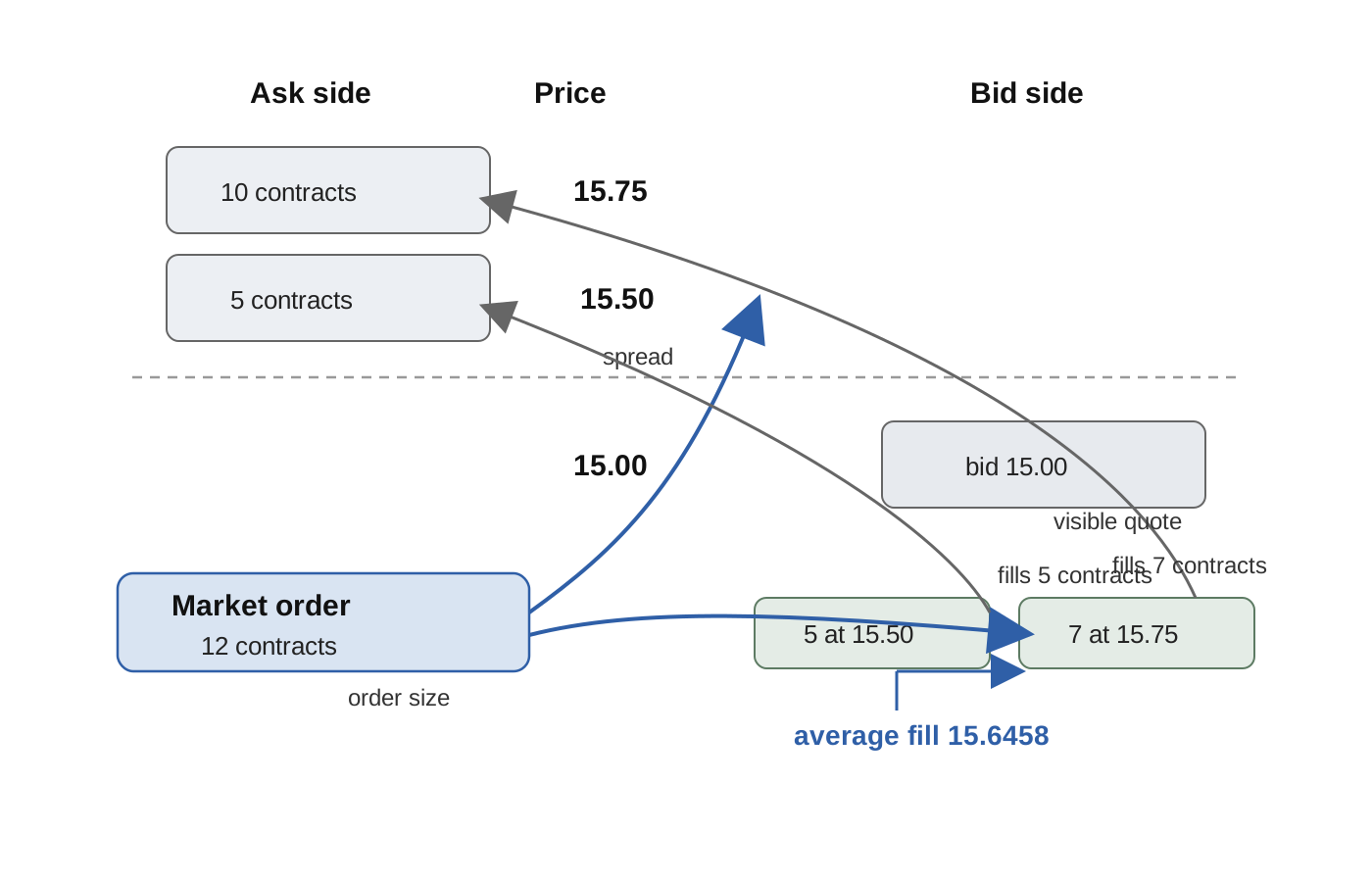
In the first case, a market order is used to buy 12 contracts. Five fill at 15.50 and seven fill at 15.75. The average price is 15.6458. If the trader had expected the visible ask of 15.50 to represent the whole order, the slippage is 0.1458 points.
In the second case, a staged limit approach is used. First, 5 contracts are bought at 15.50. Depth is reassessed. Then the trader bids 15.60 or rests at 15.55 if the market refreshes. One possible outcome is 5 filled at 15.50, 4 at 15.55, and 3 at 15.60. The average price becomes 15.5417.
Compared with the market-order outcome, the staged approach improves the average execution by 0.1041 points. The broader point is that headline activity can look fine while shallow top-of-book depth still makes order choice the main driver of actual execution quality. The cash impact for an options-on-futures trade must then be converted using that product’s own multiplier and tick rules rather than guessed.
| Measure | Basis | Value |
|---|---|---|
| Best bid | Stated quote | 15 |
| Best ask | Stated quote | 15.5 |
| Best ask size | Contracts available | 5 |
| Next ask level | Stated quote | 15.75 |
| Next ask size | Contracts available | 10 |
| Desired order size | Contracts | 12 |
| Market-order average price | 5 at 15.50, 7 at 15.75 | 15.6458 |
| Market-order slippage | Average minus visible ask | 0.1458 |
| Staged-limit average price | 5 at 15.50, 4 at 15.55, 3 at 15.60 | 15.5417 |
| Staged improvement | Market average minus staged average | 0.1041 |
| Market-order slippage | 0.1458 | |
Practical checklists
A checklist helps turn liquidity from a vague idea into a repeatable process.
Used consistently, these checks make it easier to spot when a trade is merely possible and when it is actually practical.
Pre-trade liquidity checklist
Execution and exit checklist
Glossary
- Ask
The lowest displayed price at which someone is willing to sell.
- Bid
The highest displayed price at which someone is willing to buy.
- Bid-ask spread
The difference between the ask and the bid, and a visible part of transaction cost.
- Mid price
The arithmetic midpoint between bid and ask, used as a reference rather than a guaranteed fill.
- Volume
The number of contracts traded during a period.
- Open interest
The number of outstanding contracts that remain open after clearing.
- Market depth
The quantity available at the best price and at additional price levels.
- Slippage
The difference between the expected execution price and the realised execution price.
- Fill quality
A practical assessment of how well an execution matched the quoted market, available size, and intended price control.
- Limit order
An order that specifies the worst acceptable price.
- Market order
An order to execute at the best available price, without a price cap for buys or floor for sells.
- IOC
Immediate-or-cancel, an order instruction that executes immediately in whole or part and cancels any remainder.
Verified callouts
Volume and open interest measure different things
Volume counts contracts traded during a period. Open interest counts contracts that remain open after clearing and assignment or closing activity are processed, so a contract can have high open interest without being easy to trade right now. The two measures are useful together, but neither replaces a live spread and depth check.
Spread and slippage are real cash costs
The bid-ask spread is the immediate gap between the best displayed buy and sell prices, and crossing it costs money in realised execution. Slippage is the further cost that appears when available size at the quoted price is insufficient or the market moves before the order completes. Converting both into total currency per contract and per order size makes execution quality much easier to judge.
Top-line activity does not guarantee a good fill
A contract may show respectable volume, but if only a few contracts are displayed at the inside price, a larger order can walk the book and fill at worse levels. This is why price-capped order types and depth awareness often matter more than volume alone when assessing real execution quality. Venue rulebooks and exchange protections for market orders reinforce this point operationally.
Internal links
Definitions
- Bid, ask, and mid price in options
- What bid-ask spread means in listed options
- Volume versus open interest
- Market depth in options order books
- Slippage and fill quality
- Limit orders versus market orders in options
- IOC, day, GTC, and other common order instructions
- Tick sizes and minimum price increments in options
- How market makers support listed options liquidity
- Stock options versus index options versus futures options
- Opening and closing auction mechanics for listed options
- How to calculate execution cost per options contract
Stock options, index options, and futures options
The same liquidity workflow applies to all listed options: start with the live quote, examine the size behind it, separate volume from open interest, choose the order type carefully, and think about the exit before the entry.
The differences are in emphasis. Stock options often vary widely by underlying name and strike. Index options may concentrate liquidity in key expiries and can have different tick rules and settlement features by product. Futures options often sit within the futures venue’s central limit order book and can be assessed alongside the underlying futures market, with venue-specific depth and tick conventions.
Why cash cost matters more than the label
Liquidity should be judged in money terms, not just by how active a quote appears. Converting spreads and slippage into actual cash per contract and for total order size makes the trade-off much clearer.
That principle applies across products. For equity options, the contract size means even a modest quoted spread can become meaningful when multiplied across contracts. For options on futures, the final cash effect must be converted using the product’s own multiplier and tick rules, because those terms are contract-specific.
Sources
- Characteristics and Risks of Standardized Options
- Volume and Open Interest market data pages
- Open Interest: Why It Matters
- Trading 101: Basic Order Types investor bulletin
- Investor Bulletin: An Introduction to Options
- U.S. Options Exchange Crossing Orders
- U.S. Options Exchange Complex Orders
- Options FIX Specification / Default Exchange Risk Protections
- U.S. Options Opening Process Specification
- U.S. Equities and Options NMS Plans
- Nasdaq Options 3 Rulebook
- Nasdaq Options Market overview
- Order Types
- NYSE Options market overview
- Futures Order Types
- About Quotes
- Market Depth Files FAQ
- Options on Futures brochure
- Get to know options on Micro E-mini futures
- Options on Bitcoin Futures FAQ
- Market orders explained