

How Markets, Brokers and Orders Actually Work
Overview
When people first start trading, the process can look simpler than it really is. You enter an order, the platform shows a result, and the trade appears done. In practice, there is a chain of decisions and market interactions between those two moments.
This article explains that chain in plain English, using the U.S. cash equity market as the reference model because the source material is strongest and most specific there. A market venue is a place where orders can interact. That can be an exchange, an alternative trading system, or a broker-dealer’s internal execution venue. Regulators treat these as distinct execution destinations for routing and disclosure purposes.
A broker sits between the trader and the market. The broker receives the order, applies the order instructions, decides whether to route the order or execute it internally where permitted, and remains responsible for best execution under prevailing market conditions unless the customer gives specific routing instructions.
To follow what happens next, a few market terms matter. The bid is the highest displayed price currently available from a buyer. The ask, or offer, is the lowest displayed price currently available from a seller. The spread is the difference between them, and the midpoint is halfway between bid and ask. These are not just labels on a screen. They represent the currently displayed prices a marketable order may be able to reach at that moment, although the final result can still differ if quotes change or available size is limited.
Liquidity means how easily an order can trade without materially moving the price. Depth means how many shares are available at each price level in the order book, not just at the best bid and best ask. This distinction matters because the best quote may look attractive but may not contain enough size to complete the full order.
It also helps to separate slippage from execution quality. Slippage is the gap between the price expected when the order was entered and the price actually achieved. Execution quality is broader. It includes price relative to the quoted market, speed, fill rate, price improvement, the likelihood of execution for limit orders, and the overall cost or benefit of the route chosen. In other words, a trade result cannot be judged by one number alone.
Key definitions
Step by step walkthrough
The execution loop
A useful way to understand trading is to think in a loop. First look at the current quote and available depth. Then choose the order type. Then consider liquidity, spread and volatility. Then the broker routes or executes the order. Finally review the result against what the market was showing at the time. This loop explains why identical orders can produce different outcomes in different conditions.
Worked examples
The mechanics become clearer when you see them in simple cases.
Assume a trader wants to buy 100 shares.
In the tight spread case, the best bid is 99.98 for 500 shares and the best ask is 100.00 for 500 shares. The last traded price is 99.99. A market buy order for 100 shares can fill at 100.00 if that quote is still available. Relative to the midpoint, the immediate spread cost is small, and if the full 100 shares are available at 100.00 the order completes there.
In the wide spread case, the best bid is 99.50 for 500 shares and the best ask is 100.50 for 500 shares. The last traded price is 100.00. A market buy order still crosses to the ask, but now the best available sell price is 100.50. The result may feel surprising because the last traded price was 100.00, yet market orders execute against current available offers, not against the last print. This is why a market order can fill very differently from the last traded price.
| Measure | Basis | Value |
|---|---|---|
| Tight spread best bid | 500 shares available | 99.98 |
| Tight spread best ask | 500 shares available | 100 |
| Tight spread last traded price | Last print | 99.99 |
| Tight spread market buy fill | 100 shares at the ask | 100 |
| Wide spread best bid | 500 shares available | 99.5 |
| Wide spread best ask | 500 shares available | 100.5 |
| Wide spread last traded price | Last print | 100 |
| Wide spread market buy fill | Crosses to the ask | 100.5 |
| Wide spread market buy fill | 100.5 | |
Assume a trader places a limit buy order for 1,000 shares with a limit price of 20.00. The current visible asks are 20.00 for 300 shares, 20.01 for 400 shares and 20.02 for 800 shares.
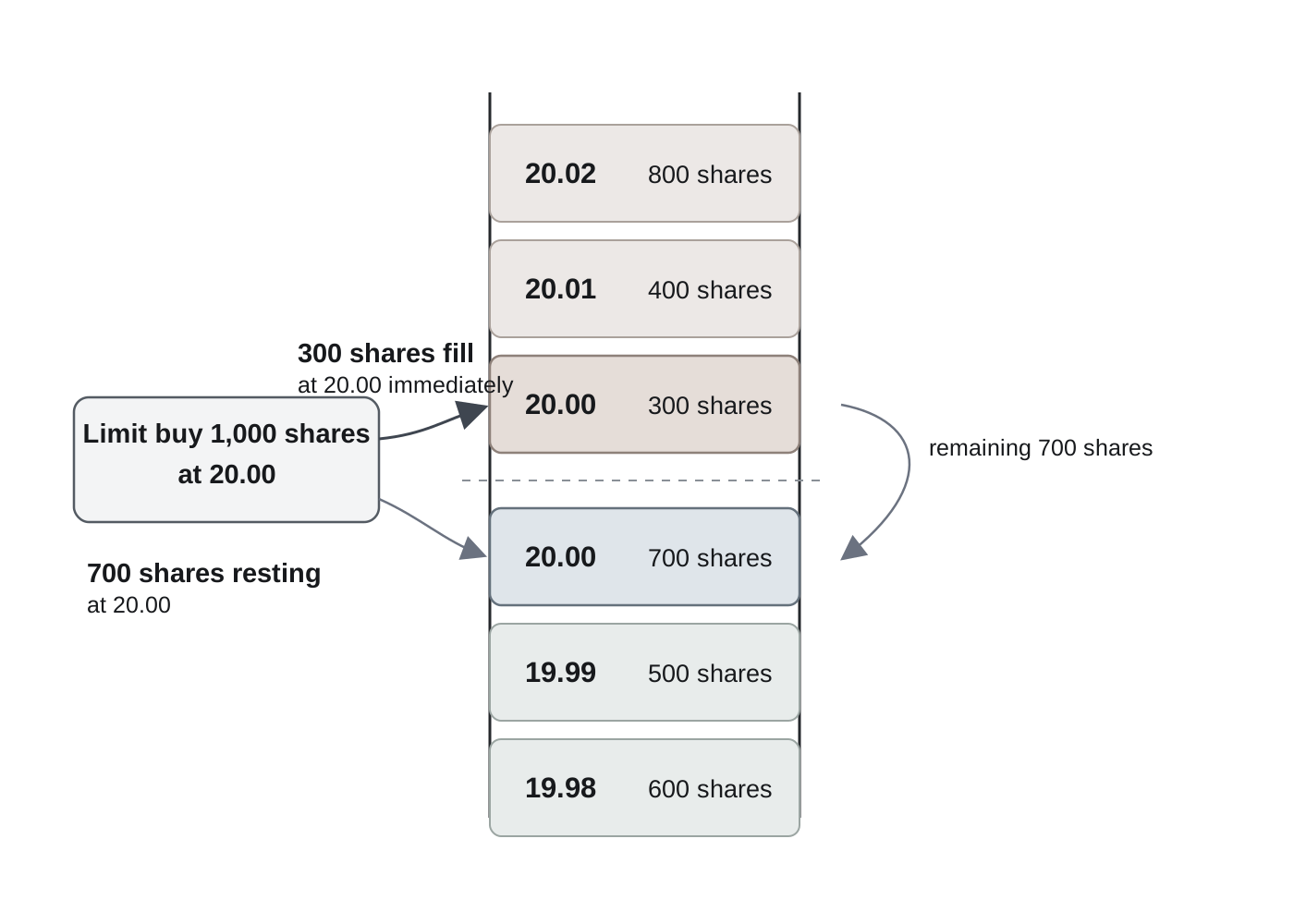
At entry, the order is marketable only up to the 300 shares available at 20.00. Those 300 shares may execute immediately at 20.00. The remaining 700 shares cannot pay more than 20.00, so they rest or remain unfilled rather than trading at 20.01 or 20.02.
Later, if another seller posts 250 shares at 20.00, those can execute too, bringing the filled total to 550 shares. If the market then moves higher and no more stock is offered at 20.00 or lower before the order expires, the remaining 450 shares do not fill.
This shows three practical points. A limit order gives price control but not execution certainty. Partial fills are normal when available size at the limit price is smaller than the order. And displayed depth can change while the order is live, so the final outcome depends on later liquidity as well as the initial quote.
| Measure | Basis | Value |
|---|---|---|
| Limit buy order size | Limit price 20.00 | 1,000 |
| Visible ask at 20.00 | 300 shares | 300 |
| Visible ask at 20.01 | 400 shares | 400 |
| Visible ask at 20.02 | 800 shares | 800 |
| Immediate fill | 300 shares at 20.00 | 300 |
| Filled after more sellers post | 250 shares at 20.00 | 250 |
| Total filled | 550 shares | 550 |
| Remaining unfilled | 450 shares | 450 |
| Total filled | 550 | |
Checklists
These lists keep the mechanics practical before and after an order is placed.
Pre-trade execution checklist
Post-fill review checklist
Glossary
- Alternative trading system, ATS
A non-exchange trading venue that matches orders under regulatory rules. SEC routing guidance treats ATSs as separate venues for routing disclosure.
- Ask, or offer
The lowest displayed price at which someone is currently willing to sell.
- Best execution
The broker’s duty to use reasonable diligence to seek the most favourable market for the order under prevailing conditions.
- Bid
The highest displayed price at which someone is currently willing to buy.
- Depth
The amount of buying or selling interest available at multiple price levels in the book.
- Execution quality
The quality of an execution measured using factors such as price relative to the quote, speed, fill size, fill probability and price improvement.
- Internalisation
Execution of customer order flow by the broker-dealer or an affiliated venue rather than routing all of it to an external venue.
- Limit order
An order to buy at a specified price or lower, or sell at a specified price or higher. It may not execute.
- Liquidity
The practical ability to trade without materially moving the price, influenced by spread, depth and available counterparties.
- Market order
An order seeking prompt execution at the best available prices, without a set execution price.
- Market venue
An exchange, ATS, broker-dealer internal venue or other execution destination where orders may be routed or executed.
- Midpoint
Halfway between the bid and ask. It is often used as a reference for measuring spread cost or price improvement.
- Partial fill
Execution of only part of an order, leaving a remainder to rest, reroute or expire.
- Settlement
The final exchange of securities and cash after execution. In U.S. equities cleared through NSCC, this is generally on T+1.
- Slippage
The difference between the expected execution level and the actual achieved price, often driven by spread, depth and price movement during execution.
- Spread
The difference between the best bid and best ask.
- Stop order
An order that becomes a market order once the stop price is reached.
- Stop-limit order
An order that becomes a limit order once the stop price is reached. It may fail to execute after trigger.
Verified callouts
What the bid-ask spread represents in practice
The spread is the gap between the highest current buying price and the lowest current selling price. In practice, it is the immediate price cost of crossing the market with a marketable order, though the full outcome still depends on available size and quote stability.
Why market orders can fill differently from the last traded price
A market order executes against the current best available bid or ask, not against the last traded price. If quotes have moved, available size has changed, or the market is volatile, the execution can differ from the last print or on-screen quote seen moments earlier.
How liquidity and order size affect slippage and partial fills
Displayed quotes only guarantee a price for the displayed size. If an order is larger than the size available at the best level, later shares may execute at worse prices or not execute at all, which is the practical source of slippage and partial fills in thin markets.
Internal links
Definitions
- What is a market venue?
- What does a broker actually do?
- What is an order book?
- What are bid, ask and midpoint?
- What is the bid-ask spread?
- What is liquidity in trading?
- What is market depth?
- What is slippage?
- What is execution quality?
- What is best execution?
- What is a market order?
- What is a limit order?
- What is a stop order?
- What is a stop-limit order?
- What is a partial fill?
- What is price improvement?
- What is order routing?
- What is internalisation?
- What are Rule 605 and Rule 606 disclosures?
- What are clearing and settlement?
Sources
- SEC, Limit Orders
- FINRA, Order Types
- SEC, Investor Bulletin: Trading Basics
- SEC, Trade Execution: What Every Investor Should Know
- FINRA Rule 5310, Best Execution and Interpositioning
- SEC, Rule 606 FAQ
- SEC, Disclosure of Order Execution and Routing Practices
- Nasdaq TotalView, complete market depth description
- Nasdaq, equity order handling summary
- DTCC, NSCC overview
- DTCC, Understanding the DTCC Subsidiaries Settlement Process
- SEC, Statement on Final Rules Regarding Order Execution Quality, 6 March 2024
- SEC, Rule 605 FAQ of 1 April 2026