

Overview
When new traders press buy or sell, it can feel as if the trade goes straight into 'the market' and comes back with a price. In practice, there is a sequence. A broker receives the order, checks it, applies the order instructions, decides whether to route it to a venue or execute it internally where permitted, and remains responsible for best execution under prevailing market conditions unless the customer has given specific routing instructions.
This article uses the U.S. cash equity market as the reference model because the approved source material is strongest and most specific there. It explains the basic parts of the process, what bid and ask prices mean in practice, why liquidity and depth matter, how common order types behave, and why the result you get may differ from the last traded price you saw on screen.
The goal is not to make trading sound complicated. It is to make the process easier to read. Once you understand how orders move through the system, ideas like spread, slippage, partial fills and execution quality become much more intuitive.
Scope and assumptions
This article describes how order handling works in practice using the U.S. cash equity market as the reference model. Terms such as exchange, alternative trading system, broker-dealer internal execution venue, Rule 605, Rule 606, FINRA best execution and T+1 settlement are used in that context because that is where the approved research is specific.
A market venue here means a place where orders can interact, such as an exchange, an alternative trading system, or a broker-dealer internal execution venue. Regulators treat these as distinct execution destinations for routing and disclosure purposes.
Venue rules can differ. For example, displayed limit orders often form the visible book and time priority commonly matters at a given price, but claims about matching priority should be limited to what a venue states about its own rules.
This article explains mechanics, not outcomes. Best execution is a process requiring reasonable diligence under prevailing market conditions. It is not a promise that every order gets the single best tick visible in hindsight.
Main narrative
Start with the basic market picture
The visible market is built from bids and asks. The bid is the highest displayed price currently available from a buyer. The ask, or offer, is the lowest displayed price currently available from a seller. The spread is the difference between them, and the midpoint is halfway between the two.
These are not just labels on a screen. They are the immediately available displayed prices at that moment. That matters because a marketable order reaches into that currently available liquidity, not into the last traded price shown on a chart.
A narrow spread usually means the immediate cost of crossing the market is lower, all else equal. A wide spread usually means that immediate cost is higher. That is why the spread is both a price signal and a rough liquidity signal, though not a complete one.
Why liquidity and depth matter
Liquidity is the practical ease of trading without materially moving the price. Depth is how many shares are available at each price level in the order book, not just at the best bid and best ask.
This distinction matters because the best quote may look attractive but only for a small number of shares. If your order is larger than the size available at the best price, later pieces may execute at worse prices, or an order with price limits may remain partly unfilled. Full depth data is useful for this reason: the top of book does not tell you everything about available liquidity.
What the broker actually does
A broker sits between the trader and the market. When you enter an order, you are not just sending a simple buy or sell instruction. You are sending a set of constraints. The order normally includes side, size, symbol and order type, and it may also include a limit price, a stop price, time-in-force or other instructions.
The broker first validates the order. At a practical level, this means checking whether the account can support the order and whether it can be accepted under market and broker rules. This stage is still the broker's intake and control layer, not the public market itself.
The broker then determines whether the order is marketable. A market order is marketable by design. A buy limit order is marketable if its limit price is at or above the best displayed ask when routed. A sell limit order is marketable if its limit price is at or below the best displayed bid.
After that, the broker may route the order to an exchange, an ATS, another broker-dealer, or execute some or all of it internally where permitted. Internal execution does not remove the broker's best execution obligations.
How the venue tries to fill the order
Once the order reaches a venue, the venue attempts to match it according to its rules. In an order-driven venue, displayed limit orders often form the visible book. At a given price level, time priority commonly matters. Nasdaq states that displayed limit orders are treated equally and executed in the order received at the same price.
A fill can happen in one piece or in several pieces. If enough shares are available at acceptable prices, the order may complete immediately. If not, it may fill partially, walk through several price levels, or leave an unfilled remainder resting if the order type allows.
This is why a displayed quote should never be read as a guarantee for the whole order. Quotes apply only to a specific number of shares. If available size is limited, you may not receive that displayed price for the entire order.
The four order types most beginners should understand
Market order
A market order seeks prompt execution at the best available prices in the market. During normal hours it will generally execute at or near the current bid or ask, but not necessarily at the exact quoted or last traded price. In fast markets or thin liquidity, the result can differ materially from what was visible a moment earlier.
Limit order
A limit order sets a maximum buy price or minimum sell price. The main advantage is price control. The trade-off is that execution is not guaranteed. It executes only at the limit price or better, if the market reaches that price while the order remains active.
Stop order
A stop order becomes a market order once the stop price is reached. After it is triggered, it no longer guarantees a particular price.
Stop-limit order
A stop-limit order becomes a limit order once the stop price is reached. That gives a price boundary after trigger, but it also creates non-execution risk because, like any limit order, it may not execute.
Why market orders can surprise people
A market order executes against the current best available bid or ask, not against the last traded price. That difference matters.
Imagine a trader wants to buy 100 shares.
In a tight market, the best bid might be 99.98 for 500 shares and the best ask 100.00 for 500 shares. A market buy for 100 shares can fill at 100.00 if that ask is still available.
In a wide market, the best bid might be 99.50 for 500 shares and the best ask 100.50 for 500 shares, while the last traded price is 100.00. The same market buy still crosses to the ask, so it may fill at 100.50, not 100.00. That can feel surprising if you are looking at the last trade, but it is exactly how market orders work. They execute against current available offers.
Why limit orders can fill only partly
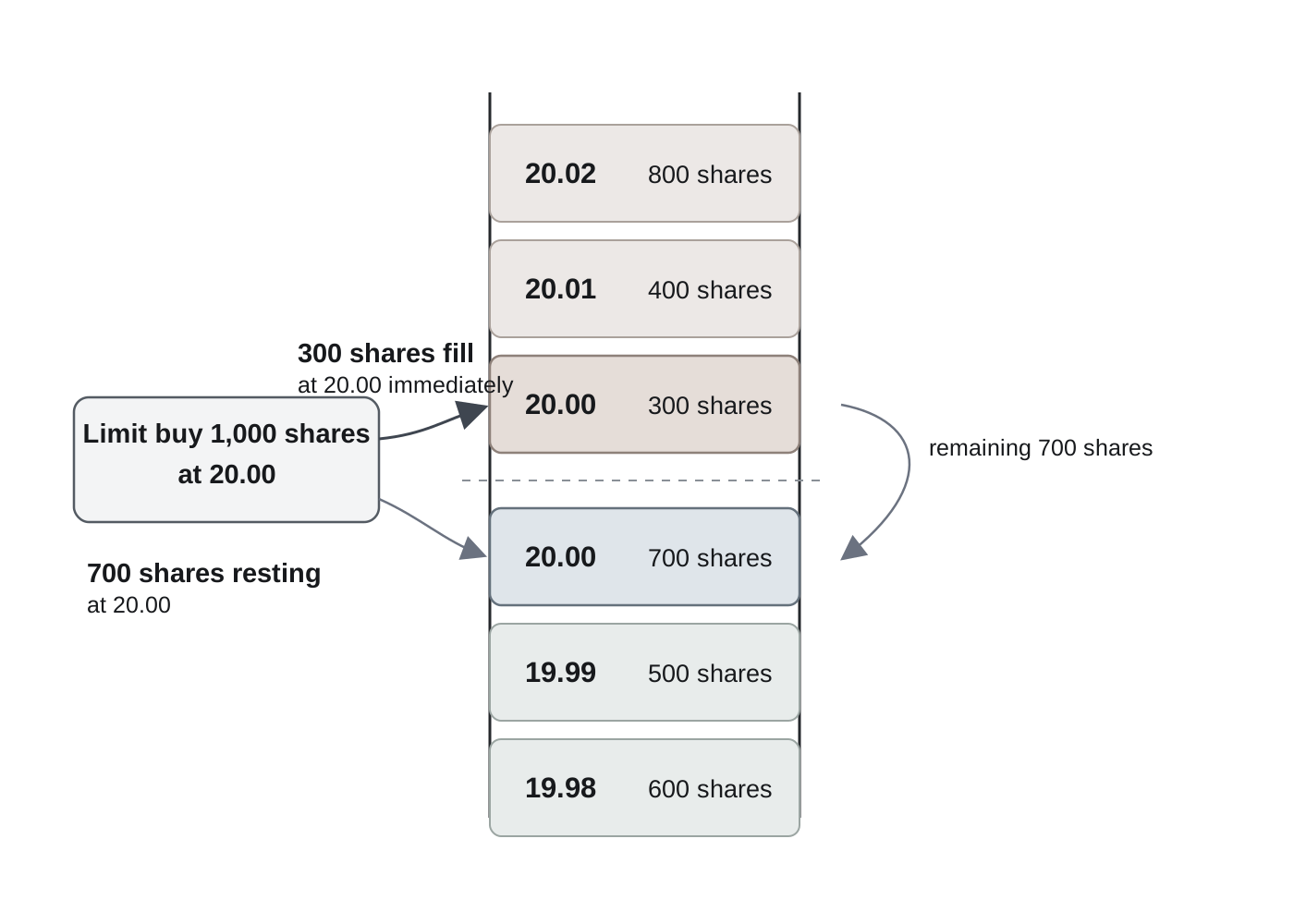
Now imagine a trader enters a limit buy for 1,000 shares at 20.00.
Current visible asks are:
- 20.00 for 300 shares
- 20.01 for 400 shares
- 20.02 for 800 shares
At entry, the order is marketable only for the 300 shares available at 20.00. Those 300 shares may execute immediately. The remaining 700 shares cannot pay more than 20.00, so they do not trade at 20.01 or 20.02. Instead, they rest or remain unfilled, depending on the order instructions.
Later, if another seller posts 250 shares at 20.00, those can also execute. That would bring the filled total to 550 shares. If the market then moves higher and no more shares are offered at 20.00 or below before the order expires, the remaining 450 shares do not fill.
This shows three things clearly: price control does not mean execution certainty, partial fills are normal when displayed size is limited, and depth can change while the order is live.
Routing and execution quality are not side issues
Routing is not just back-office plumbing. Different venues can offer different prices, displayed sizes, fill probabilities, speeds and opportunities for price improvement. That is one reason routing disclosures exist.
Execution quality is also broader than the single fill price. It includes price relative to the quoted market, speed, fill rate, price improvement, the likelihood of execution for limit orders, and the total cost or benefit of the route chosen. A fill that beats the displayed ask for a buy order or the displayed bid for a sell order has received price improvement.
Best execution should be understood in that wider sense. FINRA requires reasonable diligence, considering factors such as the character of the market, the size and type of the transaction, the number of markets checked, the accessibility of quotations and the order terms. So the correct question is not simply 'Did I get the best-looking price in hindsight?' It is closer to 'Was the order handled with reasonable diligence given the market conditions and the order instructions?'
How to review a fill sensibly
After an execution, the practical review is straightforward:
- What price was expected?
- What price was achieved?
- How many shares filled?
- Was the order complete or partial?
- Were multiple prices involved?
- Were spread width, available depth and quote movement consistent with the result?
For a limit order, an unfilled order at your chosen price is not necessarily poor handling if the market never offered enough tradable size at that price. For a marketable order, a worse-than-expected result may reflect spread, depth or quote movement rather than a malfunction.
Execution is not the same as settlement
When the match happens, the trade is executed. Settlement comes later. DTCC explains settlement as the exchange of payment to the seller and securities to the buyer, the final step in the lifecycle. In U.S. equities cleared through NSCC, this is generally on a T+1 basis, with DTC handling the book-entry movement of securities.
That final distinction matters because a trade can be done now while the movement of cash and securities happens later.
A simple pre-trade habit can improve understanding: check the current bid, ask, spread and visible size at the best price, then choose the order type that matches your actual constraint, whether that is urgency, price limit or trigger condition.
A market order controls execution urgency, not final price. In fast or thin markets, the result may differ materially from the quote or last traded price seen moments earlier.
A limit order provides price control but no guarantee of execution, even if it is the more cautious choice in some situations.
A stop order becomes a market order once triggered, so it does not guarantee a specific execution price after trigger.
A stop-limit order adds a price boundary after trigger, but it may fail to execute at all.
Displayed quotes apply only to a specific number of shares. If order size exceeds available size at the best level, later shares may execute at worse prices or remain unfilled.
Internal execution is still subject to best execution obligations. Internal handling does not by itself mean the broker's responsibilities disappear.
Execution quality is multi-factor. Judging a trade only by one fill price can miss speed, fill probability, price improvement and whether the order completed.
Execution and settlement are different stages. A trade may be executed immediately even though cash and securities settle later.
Verified callouts
What the bid-ask spread represents in practice
The spread is the gap between the highest current buying price and the lowest current selling price. In practice, it is the immediate price cost of crossing the market with a marketable order, though the full outcome still depends on available size and quote stability.
Why market orders can fill differently from the last traded price
A market order executes against the current best available bid or ask, not against the last traded price. If quotes have moved, available size has changed, or the market is volatile, the execution can differ from the last print or on-screen quote seen moments earlier.
How liquidity and order size affect slippage and partial fills
Displayed quotes only guarantee a price for the displayed size. If an order is larger than the size available at the best level, later shares may execute at worse prices or not execute at all, which is the practical source of slippage and partial fills in thin markets.
Update log
- SEC, Limit Orders
- FINRA, Order Types
- SEC, Investor Bulletin: Trading Basics
- SEC, Trade Execution: What Every Investor Should Know
- FINRA Rule 5310, Best Execution and Interpositioning
- SEC, Rule 606 FAQ
- SEC, Disclosure of Order Execution and Routing Practices
- Nasdaq TotalView, complete market depth description
- Nasdaq, equity order handling summary
- DTCC, NSCC overview
- DTCC, Understanding the DTCC Subsidiaries Settlement Process
- SEC, Statement on Final Rules Regarding Order Execution Quality, 6 March 2024
- SEC, Rule 605 FAQ of 1 April 2026