

Overview
Liquidity in listed options is the practical ability to enter, adjust, and exit at prices close to the fair price, in useful size, without paying more than necessary in spread or slippage. That sounds simple, but it depends on more than whether a contract appears active on screen.
In practice, liquidity is shaped by the bid and ask, the gap between them, the size available at those prices, the number of participants updating quotes, the venue’s tick rules, and the order type used. The key distinction is that quoted liquidity is not the same as executable liquidity. A one-tick spread can still be thin if only one contract is displayed. A contract with high open interest can still be awkward to trade if today’s quotes are wide or depth is poor.
That is why liquidity should come first. Before thinking about trade direction or payoff, it helps to ask a more practical question: can this line actually be traded well now, and is it likely to remain tradable later if an adjustment or exit is needed?
Scope and assumptions
This article uses a venue-aware, series-specific view of liquidity in listed options. The same broad workflow applies across stock options, index options, and futures options, but the details can differ by product and venue, including tick increments, displayed depth, and trading mechanics.
The goal here is not to promise a fill at mid or present a fixed rule for execution. Mid is a reference for negotiation, not a guarantee. Volume and open interest are context signals, not execution guarantees. Depth can change by time of day, especially near the open, near the close, and around scheduled events.
A practical mindset helps: judge what is tradable now using the live quote, available size, current activity, and the order type you are willing to use.
Main narrative
A good liquidity check starts with the live quote, not yesterday’s activity. Look at the bid, ask, spread, and the quoted size on each side if available. A narrow spread is usually favourable, but only if there is enough size to support the intended order. If the quote is already wide, the likely cost of getting in and out rises straight away.
Next, translate the spread into cash. Option premiums are quoted per share unit, but one standard U.S. equity option contract usually represents 100 shares. That means even a small-looking spread can become meaningful once converted into actual money per contract and for total order size. This step stops a trader from treating spread as a cosmetic number instead of a real trading cost.
Then separate volume from open interest. Volume tells you whether the contract has traded during the session. Open interest tells you how many contracts remain open after clearing. They are related, but they do not answer the same question. High volume can appear in short bursts without stable depth. High open interest can reflect positions opened earlier while current quotes remain poor. Used together, they give context. Used alone, either can mislead.
After that, look beyond the best bid and offer. Depth matters because the inside quote may only be available in small size. If only a few contracts are displayed at the ask and your order is much larger, the visible ask is not the whole story. Part of the order may fill at worse prices. This becomes especially important in thinner books and during periods when quotes are moving quickly.
Time of day matters for the same reason. Opening periods, closing periods, and event windows can widen spreads and make displayed depth less dependable. A line that looks manageable during steadier trading can behave differently during these transition periods.
Order type should match the liquidity on offer. A market order seeks execution, but it does not cap price. A limit order defines the worst acceptable buy or sell level, though it may not fill. Immediate-or-cancel instructions can help when you want a quick answer without leaving the remainder resting in the book for long. The practical lesson is clear: when liquidity is uncertain, price control matters.
A useful process is to negotiate from the inside out. If the quote is 2.00 bid and 2.20 ask, the mid is 2.10. Starting with a passive or mildly aggressive limit near mid gives you a reference point for price discovery. If nothing fills, reassess the book rather than assuming the mid was ever truly available in your size. In deeper and more competitive markets, execution may happen at or near mid. In thinner markets, a realistic fill may sit closer to the ask for a buy or the bid for a sell.
It also helps to plan the exit before the entry. Liquidity matters twice. A line that is just tradable enough on the way in may become expensive to adjust or close later if activity fades, the strike drifts out of focus, or the session becomes less active. The same spread, depth, and order-type logic used for entry should be used when thinking about the exit.
A simple loop is: quote -> size -> activity -> order choice -> reassess -> exit plan.
The spread is the most visible estimate of friction. Its importance depends on context. A $0.05 spread on a $5.00 option is very different from a $0.20 spread on a $0.40 option. Tick size matters too, because options cannot quote in arbitrary increments and the narrowest possible spread depends on the venue and product.
A worked stock option comparison makes the point. If two 10-contract call positions both have a theoretical fair value near $2.10, but one trades 2.08 bid and 2.12 ask while the other trades 1.95 bid and 2.25 ask, the difference in actual cost is material. Buying the tighter line at the ask instead of the reference mid costs $20. Buying the wider line at the ask instead of the same reference mid costs $150. If the wider position is then sold straight back at the bid, the round-trip spread loss versus mid-to-mid is $300. Spread quality is not just a screen detail. It is a cash cost.
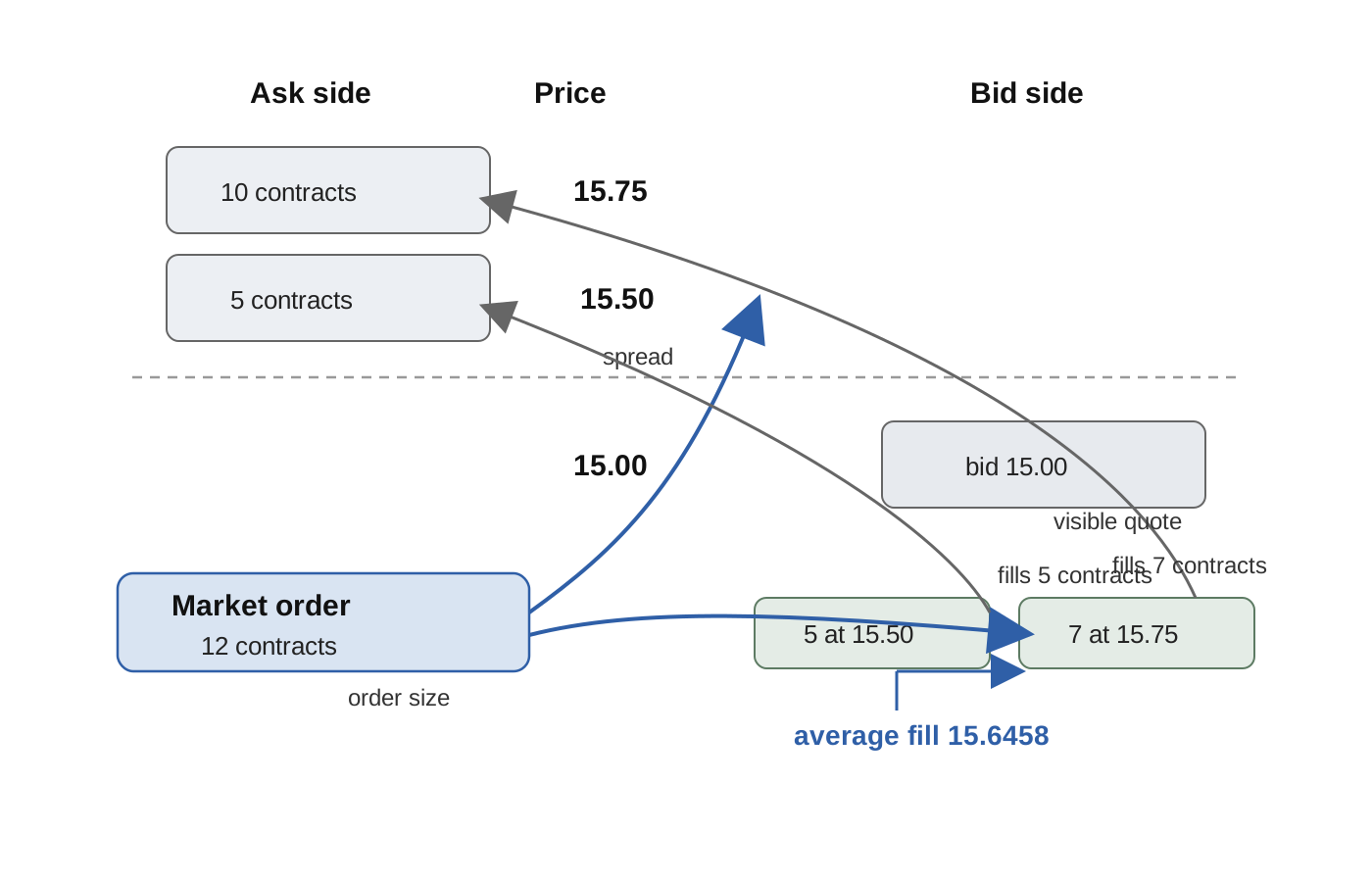
Depth and order choice matter just as much in larger or more layered books. Suppose an index option on futures is quoted 15.00 bid and 15.50 ask, with only 5 contracts available at 15.50 and the next 10 at 15.75. A 12-lot market order would fill partly at both levels, producing an average price of 15.6458. A staged limit approach could instead fill 5 at 15.50, 4 at 15.55, and 3 at 15.60 for an average of 15.5417. That improves execution by 0.1041 points relative to the market-order case. The lesson is straightforward: respectable headline activity does not guarantee a good fill if top-of-book depth is shallow.
A practical pre-trade checklist is simple: check live bid and ask, convert the spread into total cash, look at today’s volume, check open interest, inspect displayed size and if possible more than one level of depth, note the time of day, confirm tick size and contract multiplier, and decide your worst acceptable price before sending the order.
During execution, if size is large relative to displayed depth, stage the order or reassess. After any partial fill, re-check the inside market and remaining depth. Before holding the position, confirm that the likely exit line still looks reasonably quoted. Then record the expected price, actual average fill, and total slippage in cash terms for review.
Quoted liquidity can be misleading. A tight displayed spread does not guarantee meaningful executable size.
High volume or high open interest on its own does not guarantee that a contract is easy to trade right now.
Market orders prioritise execution, not price protection, and can perform badly in thin or fast-moving options markets.
Displayed depth can change around the open, the close, and scheduled event windows, so fills may differ from what the screen suggested moments earlier.
Entry liquidity is not enough on its own. A position can become harder or more expensive to adjust or exit later.
Verified callouts
Volume and open interest measure different things
Volume counts contracts traded during a period. Open interest counts contracts that remain open after clearing, so a contract can show high open interest without being easy to trade right now. Both are useful context, but neither replaces a live spread and depth check.
Spread and slippage are real cash costs
Crossing the bid-ask spread costs money in realised execution, and slippage adds further cost when the displayed size is not enough or the market moves before the order completes. Converting both into total cash per contract and per order size makes execution quality easier to judge.
Top-line activity does not guarantee a good fill
A contract may show respectable volume, but if only a few contracts are available at the inside price, a larger order can walk the book and fill at worse levels. That is why depth awareness and price-capped order types often matter more than volume alone.
Update log
- Characteristics and Risks of Standardized Options
- Volume and Open Interest market data pages
- Open Interest: Why It Matters
- Trading 101: Basic Order Types
- Investor Bulletin: An Introduction to Options
- U.S. Options Exchange Crossing Orders
- U.S. Options Exchange Complex Orders
- Options FIX Specification / Default Exchange Risk Protections
- U.S. Options Opening Process Specification
- U.S. Equities and Options NMS Plans
- Nasdaq Options 3 Rulebook
- Nasdaq Options Market overview
- Order Types
- NYSE Options market overview
- Futures Order Types
- About Quotes
- Market Depth Files FAQ
- Options on Futures brochure
- Get to know options on Micro E-mini futures
- Options on Bitcoin Futures FAQ
- Market orders explained