

Overview
Risk in trading is not just the chance that price moves the wrong way. It is uncertainty plus consequences: how much could be lost, how fast it could happen, under what conditions, and whether the account can keep going afterwards. A risk first approach starts there. Before asking what a trade could make, it asks what could go wrong, what that would cost, and whether the account can survive it.
That change in order matters. A sound workflow defines the maximum acceptable loss first, then position size, then account level impact, then event and correlation risks, then exit handling. Only after those are clear does it make sense to measure possible return.
In plain English, the key question is simple: if this trade loses the full planned amount, does the account remain stable and can the next trade be taken without pressure to recover?
Scope and assumptions
This article explains a risk first trading workflow using the approved research only. It focuses on practical ideas that apply across the trade lifecycle: before entry, during the trade, and at exit.
The core terms are used in their plain operational sense. Risk is the chance of a negative financial outcome that matters to the account. Reward is the gain if the trade works as intended. Drawdown is the decline from an account peak to a later low before recovery. Position sizing means choosing trade size so that a defined loss at the stop or invalidation point equals an acceptable cash amount.
Leverage and margin are exposure tools, not protection. Margin is a deposit or collateral requirement and is not the maximum possible loss. Stops can help limit losses, but they are not guaranteed in all market conditions.
Main narrative
A complete risk assessment covers three moments: before entry, during the trade, and at exit. Before entry, define where the trade is wrong. Convert that distance into cash risk per unit. Choose position size so the loss at that invalidation point stays within the maximum acceptable loss. Then check leverage, margin, gap and slippage risk, concentration, correlation, event risk, and how the trade will be managed if conditions change.
During the trade, reassess open risk rather than staring only at unrealised profit or loss. Volatility can change. Margin requirements can change. Correlation can rise. New event risk can appear. A trade can feel more certain as it moves, but increasing size for that reason alone can raise account risk quickly. If the original stop is moved further away, account risk changes immediately.
At exit, compare the planned risk with the realised loss. Record slippage, gaps, and whether the actual loss exceeded the intended loss. Then measure the drawdown effect on the account and base future size on current equity rather than an old account peak. The point is not to avoid every loss. It is to preserve account survival through normal losing periods, friction, and mistakes.
Start with maximum acceptable loss
The first number in the plan should be a real cash amount that is acceptable if the trade fails. In a £10,000 account, that might be 1%, or £100. This is the risk budget for the trade. It should allow for more than chart distance alone because fees, spread, slippage, overnight gaps, and leverage can all affect the true loss.
Then calculate position size
Position size = maximum cash risk ÷ risk per unit
If a share trade has an entry at £50 and a stop at £48, the risk per share is £2. If the maximum acceptable loss is £100, the maximum size is 50 shares. The total position value is £2,500, but the planned loss at the stop is £100 before costs. This is why position sizing is a risk control, not a return prediction tool.
Worked example with friction included
Assume:
- account equity: £10,000
- maximum risk per trade: 1% = £100
- planned entry: £50
- stop: £48
- estimated costs and slippage allowance: £10
Price risk per share is £2. If £10 is reserved for costs and slippage, £90 remains for pure price risk. £90 ÷ £2 gives a maximum size of 45 shares. Position value is 45 × £50 = £2,250. Planned loss is £90 from price movement plus £10 allowance, for a total of £100.
If the market gaps below the stop and execution happens at £47.50 instead, the actual price loss becomes 45 × £2.50 = £112.50, plus costs. That is why stops are tools, not promises.
Per trade risk also has to be tested against losing sequences, not just one trade. Drawdown is what matters to account survival. If a £10,000 account risks 1% of current equity per trade and takes five consecutive losses, the equity falls to about £9,509.90, a drawdown of about 4.9%. Because risk was scaled to current equity, damage slowed slightly as the account shrank.
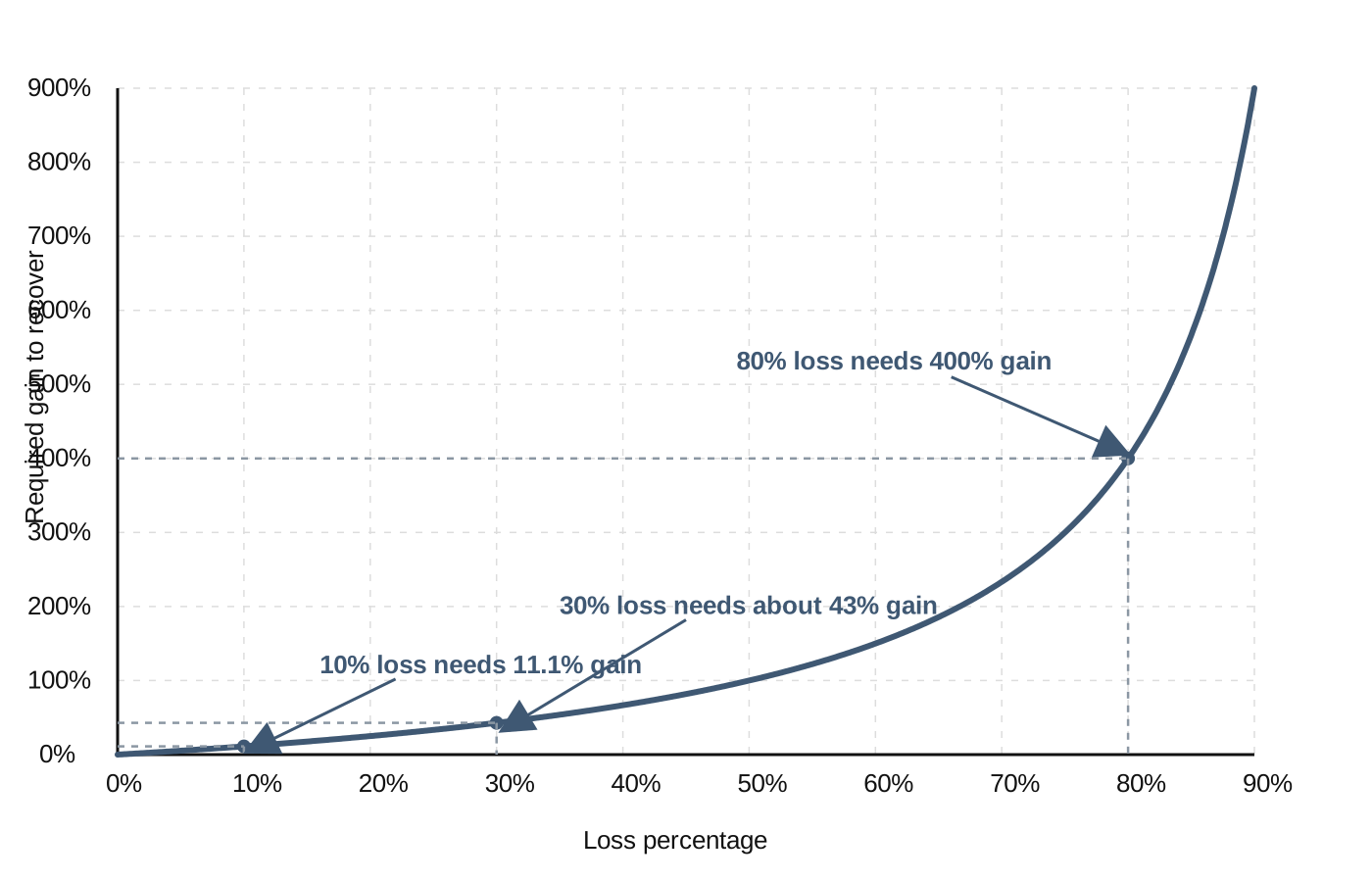
Recovery gets harder as drawdown deepens. A 10% loss needs an 11.1% gain to recover. A 30% loss needs about 43%. An 80% loss needs 400%. This asymmetry is basic arithmetic and explains why preserving capital matters more than chasing large returns.
Portfolio level risk can also be larger than it first appears. Per trade risk is the planned loss on one position. Portfolio risk is the combined effect of all open positions. Event risk comes from scheduled or unscheduled events. Correlation risk appears when positions move together. Several positions in the same sector, region, or theme can behave like one larger trade when markets are stressed.
Leverage makes that more dangerous. It makes small market moves matter more in account terms, can create losses larger than the initial capital committed in some products, and can trigger margin pressure or forced liquidation if equity falls or requirements rise. Leverage and correlation together can increase risk faster than position counts suggest.
Define exit rules before entry
At minimum, a risk first plan should set:
- the invalidation or stop level
- whether the stop is normal, manual, or guaranteed if available
- whether size will be reduced into events
- whether the stop can ever be widened
- what happens if the market gaps beyond the stop
- the maximum holding period if the setup stagnates
This matters because stop behaviour in volatile markets can introduce its own risks.
Only after loss has been defined, sized, and tested at account level should return be assessed. A risk-reward ratio such as risking £100 to target £200 can be useful, but by itself it is incomplete. It says nothing about probability of winning, slippage, gaps, costs, or whether several open trades create concentrated exposure. In a risk first workflow, return is evaluated after survival, not instead of it.
A practical pre-trade check is to ask: what specific event makes this trade wrong, what is the maximum acceptable cash loss, what size keeps the loss within that amount, and does the account still remain stable if execution is worse than planned?
Stops can help limit losses, but they are not guaranteed to execute at the chosen price in all market conditions. Volatility and gaps can lead to larger realised losses than planned.
Leverage magnifies gains and losses, and in some products losses can exceed the initial outlay committed to the trade.
Margin is a deposit or collateral requirement, not a measure of maximum loss.
Concentration and correlation can make several separate positions behave like one larger risk, especially during stress.
Large drawdowns reduce both capital and flexibility, and they require disproportionately larger gains to recover.
An attractive headline risk-reward ratio does not by itself show that a trade is sound.
Verified callouts
Why losses and recovery are asymmetrical
A loss shrinks the capital base, so the percentage gain needed to get back to the starting point is always larger than the percentage loss that caused the damage. For example, a 10% loss needs an 11.1% gain to recover, while a 30% loss needs about 43%. This is arithmetic, not opinion, and it is one reason drawdown control matters so much.
Position size controls loss; it does not predict outcome
Position sizing converts a chosen maximum cash loss into an allowable trade size. It answers how big the trade can be if the idea is wrong, rather than how much it will make if the idea is right. Official investor education and exchange materials support this distinction between exposure, leverage, margin, and certainty about return.
Leverage and correlation can make separate trades behave like one larger risk
Leverage magnifies the account impact of small price moves, and correlated positions can suffer losses together during stress. Official risk materials warn that leverage can accelerate losses, while concentration and correlation can amplify portfolio damage even when individual positions look modest on their own.
Update log
- Risk
- Stop Orders: Factors to Consider During Volatile Markets
- Concentrate on Concentration Risk
- Asset Allocation and Diversification
- Leveraged Investing Strategies: Know the Risks Before Using These Advanced Investment Tools
- Foreign Currency Exchange (Forex) Trading For Individual Investors
- Investor Alert: Binary Options and Fraud
- Margin: Know What’s Needed
- Clearing House Risk Management
- PS19/18 Restricting contract for difference products sold to retail clients
- Slippage Definition
- Putting A Stop To It