

Overview
Options can look similar on a screen while behaving very differently at expiry. The key difference is the underlying security. In the US listed market, options on individual equities and ETFs, options on equity indices, and options on futures each have their own settlement mechanics, contract terms, trading sessions, and margin frameworks.
A useful starting point is simple: first identify the underlying, then confirm what exercise actually leads to. Equity options generally deliver shares, most broad-based index options settle in cash, and options on futures exercise into a futures position. From there, the practical details such as multiplier, tick size, last trading day, exercise style, and venue calendar become much easier to understand.
Across products, contract specifications matter. You should confirm the exact product terms rather than assume that one option category works like another.
Scope and assumptions
This article covers listed options across three US market underlyings: individual equities and ETFs, equity indices, and futures. It focuses on what is delivered or settled, the contract specifications that matter in practice, trading hours and calendar checks, margining and clearing flows, and the structural reasons liquidity differs across products.
The discussion follows the same decision sequence used in the research: define the underlying and deliverable, check the contract specification, map the trading session and calendar, understand margining and clearing, and then plan for liquidity and execution.
Broker policies can add earlier exercise deadlines and stricter house margin requirements than the market-wide baseline. Those firm-level rules must be checked separately.
Main narrative
Start with the underlying and the deliverable
The most practical first question is not price or strategy. It is: what do I end up with if this option is exercised?
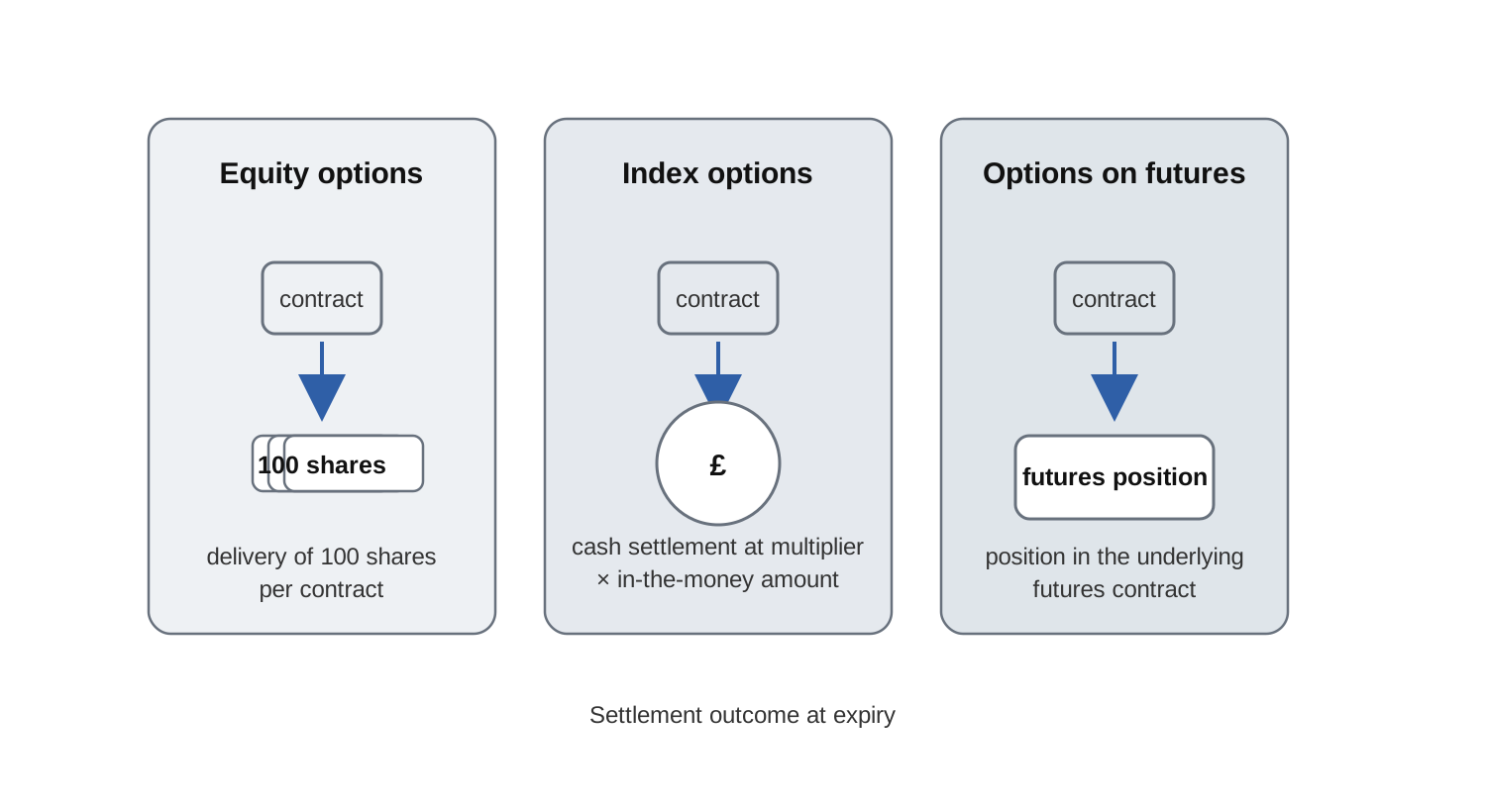
For equities and ETFs, exercise generally means physical delivery of shares, usually 100 shares per contract, unless the contract has been adjusted for corporate actions. These options are generally American style, so they can be exercised on any business day up to and including expiration.
For equity indices, the outcome is usually different. Most broad-based index options are cash settled, not settled in shares. Many major index series such as SPX, RUT and NDX suites are generally European style, which means no early exercise. There are exceptions within index products, such as OEX, which is American style.
For futures, exercise does not produce cash or shares. It produces a position in the underlying futures contract. Style varies by product and expiry. In the S&P 500 family at CME, both American-style and European-style series exist, depending on the product specification.
Then check the contract specification
Once you know the underlying category, the next step is to read the contract specification. This is where the practical differences show up.
For equity and ETF options, premiums are quoted in dollars per share, with a typical 100 multiplier. Minimum tick sizes depend on whether the class is eligible for the Penny Programme.
For index options, multipliers are commonly 100 times the index level, although some contracts are scaled by design. A useful example is XSP, which is one tenth of SPX while still using a 100 multiplier. Expiration can also differ by series, including A.M. settled and P.M. settled variants.
For options on futures, the contract economics are tied to the futures family. For example, ES is 50 dollars per index point and MES is 5 dollars per index point. The option inherits that futures notional structure.
Trading hours and calendar checks matter more than many traders expect
Trading hours are not uniform across these products.
For US equity and index options on Cboe, the regular session is 09:30 to 16:00 Eastern Time. Some index products also have Global Trading Hours. Cboe offers those extended hours for selected products including SPX, XSP, VIX and RUT, from 20:15 to 09:15 ET.
For CME equity index futures options, trading is much longer, running from Sunday 18:00 ET to Friday 17:00 ET, with a daily maintenance break.
The final trading time can also vary by product. Expiring equity options generally trade until 16:00 ET on expiration day. Some SPX A.M.-settled series stop trading the business day before the settlement calculation. Many European-style CME weeklies align to a 16:00 ET close, but the exact last trading time is product specific. Holiday schedules can alter sessions and cut-offs, so the venue calendar should always be checked.
Settlement and exercise mechanics are not interchangeable
This is where the differences become operational.
For equities, if an option is exercised or assigned, shares and cash settle T+1 after exercise. OCC uses exercise by exception for expiring equity options that are at least 0.01 in the money, unless contrary instructions are submitted. Final exercise decisions must reach OCC by 17:30 ET, although brokers often impose earlier internal deadlines.
For indices, settlement is typically a cash credit or debit on the business day after expiration. For P.M.-settled contracts, the settlement value is based on the official closing index level. For A.M.-settled contracts, it is based on a special opening quotation drawn from opening prints of the constituent securities. Because many broad-based index options are European style, there is often no early exercise.
For futures options, in-the-money options exercise into the designated futures contract for that series. In some products, such as certain European-style E-mini S&P 500 weeklies, exercise on expiry results in a position in the nearest expiring quarterly E-mini future, and contrarian instructions are generally prohibited. After exercise, the resulting futures position is handled through the normal variation margin process at CME Clearing.
Margin and clearing depend on the product family
Listed equity and index options are cleared at OCC. Customer margin follows FINRA Rule 4210, with both strategy-based margin and portfolio margin frameworks available depending on the account. OCC margins clearing members using STANS, its risk-based methodology.
Futures options are cleared at CME Clearing. Margin is based on SPAN-style portfolio risk, with short option minimums where needed. Most CME options are premium-style, meaning the buyer pays premium up front while the seller posts margin. If an exercised option becomes a futures position, that new position is then margined and settled like any other futures position.
At the broker level, firms can layer on stricter rules. They may require more margin than the exchange minimum and may set earlier cut-offs for exercise and contrary instructions.
Why liquidity can differ so much across products
Liquidity tends to concentrate where order flow concentrates.
That helps explain why flagship index options can look different from equity options. SPX is exclusively listed at Cboe, which concentrates trading interest and displayed depth in one venue. By contrast, equity options are multiply listed across many exchanges. Their quotes and trades are consolidated through OPRA for the NBBO, but the actual order flow is still fragmented across venues and series.
Futures options centralise on CME Globex and trade nearly continuously, which supports participation across global time zones.
In practical terms, that structure can affect both spread width and displayed size. When choosing a product and expiry, it is sensible to look for the tightest market that still offers enough depth for the trade you want to place.
A simple cross-security decision loop
A practical way to compare option products is to move through the same sequence every time:
- Identify the underlying category: equity, index, or futures.
- Confirm settlement and exercise style: physical shares, cash, or futures delivery.
- Check contract size and tick size: multiplier, quoting convention, and minimum increment.
- Verify trading hours and last trading day: including whether a contract is A.M. or P.M. settled.
- Understand the margin framework: OCC and FINRA-based customer margin for listed securities options, or CME SPAN-style performance bonds for futures options.
- Assess liquidity structure: exclusive listing, multiply listed venue fragmentation, or centralised futures trading.
That process keeps the core differences separate instead of blending them into one vague view of "options".
Worked example 1: an equity option
Assume you buy 1 XYZ 50 call expiring on Friday. The contract multiplier is 100 shares and the premium is 2.00 dollars per share, so the total premium paid is 200 dollars, excluding fees. The option is American style and physically settled.
Outcome A: the option expires in the money
If XYZ closes at 51.20 on expiration Friday, the option is in the money. Under OCC's exercise-by-exception process, and absent contrary instructions, it is automatically exercised. You buy 100 shares at 50.00, so you pay 5,000 dollars on exercise date Friday. The shares settle T+1, which would be Monday if that is a business day.
Ignoring costs, the option's intrinsic value is 1.20 × 100 = 120 dollars. Against the 200 dollar premium, that is a net loss of 80 dollars. From settlement onward, you hold the shares and carry the market risk of that stock position.
Outcome B: the option expires out of the money
If XYZ closes at 49.90, the option expires worthless. No exercise occurs, no shares are delivered, and the loss is the 200 dollar premium.
Worked example 2: a futures option on an index future
Assume you buy 1 ES European-style Tuesday weekly 6000 call. The underlying is the E-mini S&P 500 future, with a multiplier of 50 dollars per index point. The premium paid is 10.00 index points.
The premium outlay is 10.00 × 50 = 500 dollars.
If, at 16:00 ET on expiry Tuesday, the relevant ES settlement reference is 6020, the option is 20 points in the money. In this product type, exercise results in a position in the nearest expiring quarterly E-mini S&P 500 future. You become long 1 ES future at the strike of 6000.
From that point onward, the contract is no longer an option position. It is a futures position, and its gains and losses are processed through daily variation margin at CME Clearing. The resulting futures position appears after CME's processing cycle for the session.
This example highlights a key difference from index cash settlement and from equity share delivery: the expiry event creates a new futures exposure rather than a cash amount or a stock position.
A practical pre-trade and expiry checklist
Before trading across these products, it helps to check the same points every time:
- Identify whether the underlying is an equity, index, or futures contract.
- Read the product specification to confirm exercise style and settlement type.
- Confirm the multiplier, minimum tick, and quoting convention.
- Verify trading hours, last trading day, and whether the contract is A.M. or P.M. settled.
- Check the margin framework and whether portfolio margin or SPAN-style offsets apply.
- Assess the product's liquidity structure, including exchange exclusivity, NBBO consolidation, or centralised CME trading.
As expiry approaches, also confirm:
- The 17:30 ET industry exercise cut-off at OCC and any earlier broker deadline.
- Whether settlement will be shares on T+1, cash the next business day, or a futures position with ongoing mark-to-market.
- Any holiday-related early closes or modified sessions.
- Whether your account has capacity for the resulting stock or futures exposure if exercise or assignment occurs.
Do not assume all listed options settle the same way. Equity options generally deliver shares, broad-based index options often settle in cash, and futures options can create a futures position.
Exercise style matters. Many equity options are American style, while many broad-based index options are European style with no early exercise.
A.M.-settled and P.M.-settled index series can stop trading at different times and use different settlement calculations.
Broker cut-offs for exercise and contrary instructions are often earlier than the market-wide deadline.
An exercised futures option can create a margined futures position, so expiry can increase risk rather than simply end it.
Liquidity conditions differ structurally across exclusive, multiply listed, and centrally cleared venues, which can affect spreads and execution quality.
Verified callouts
Settlement style depends on the underlying
Most US equity options are American style and physically settled in 100-share units when exercised. Broad-based index options such as SPX and RUT are cash settled and generally European style, while options on futures at CME exercise into a futures position according to the product specification.
Multipliers shape the real exposure
Equity and index options commonly use a 100 multiplier, while scaled designs such as XSP are one tenth of SPX but still use a 100 multiplier. ES futures are 50 dollars per point and MES futures are 5 dollars per point, and options on these futures inherit that notional structure.
Trading hours vary sharply by product
US equity options trade during the regular 09:30 to 16:00 ET session, selected Cboe index products also trade during Global Trading Hours from 20:15 to 09:15 ET, and CME equity index futures options trade from Sunday 18:00 ET to Friday 17:00 ET with a daily maintenance break.
Update log
- OCC, Characteristics and Risks of Standardized Options, June 2024 ODD and Supplement
- OCC, Equity Options Product Specifications
- FINRA, Rule 4210 Margin Requirements and Interpretations
- FINRA, Information Notice on Exercise Cutoff
- OCC, Rules including Rule 805 exercise by exception
- Cboe, US Options Hours & Holidays
- Cboe, SPX Options Product Specifications and Fact Sheet
- Cboe, XSP Mini-SPX materials
- Cboe, Russell 2000 Index Options specifications
- Cboe, IR statement confirming SPX exclusivity
- CME Group, Holiday and Trading Hours
- CME Group, SPAN methodology and margin model
- CME Group, Options on Micro E-mini S&P 500 and Nasdaq-100 futures FAQs and fact card
- CME Group, E-mini S&P 500 European-style Tuesday and Thursday Options FAQs
- OPRA, official site describing its consolidated feed