

Overview
Margin lets a trader take on exposure that is larger than the cash they put in. But margin does not work in exactly the same way across every product, and that distinction matters.
In a securities margin account, the broker lends part of the purchase price and charges interest on the debit balance. In futures, margin is not a loan for part-payment of the contract. It is a performance bond that supports a much larger notional exposure, with gains and losses settled through daily mark to market. In CFDs, margin is also collateral supporting exposure rather than ownership of the underlying asset. Leveraged ETFs differ again because the investor may buy the fund without borrowing in the account, while the fund itself uses derivatives and financing arrangements to target a daily multiple of an index move.
The common thread is leverage. When exposure is larger than your own equity, a small move in the underlying asset produces a larger percentage move in your account equity. If losses push equity below the required maintenance level, the broker or provider can ask for more funds, reduce positions, or liquidate positions. Firms can also impose stricter in-house requirements than minimum rules and can raise those requirements when markets become more volatile.
A simple way to think about leverage is this: do not start with the cash you put in. Start with the total exposure you have taken on and ask how much equity is at risk if the market moves against you.
Scope and assumptions
This article explains the mechanics of margin, leverage, equity erosion, maintenance requirements, margin calls and liquidation using the approved research only. It covers the key operational differences between securities margin accounts, futures, CFDs and leveraged ETFs.
The focus is educational and practical rather than strategic. The aim is to show why losses can escalate, how margin rules interact with falling prices, and why waiting until an account is under pressure can leave fewer choices.
Examples use simplified figures to make the mechanics clear. Where noted, commissions and short-term accrued interest are ignored for simplicity, even though in practice those costs can slightly worsen outcomes over time.
Specific margin percentages, close-out rules and operational details can vary by firm, product and jurisdiction. Firms may apply stricter house requirements than general minimums and may increase them in volatile conditions.
Main narrative
Most beginners hear that leverage can magnify gains. The more important lesson is that it magnifies losses too, and often faster than expected.
Start with the definitions. Margin is collateral posted to support a leveraged position. Initial margin is the minimum collateral needed to open the trade. Maintenance margin is the minimum ongoing equity or collateral needed after the trade is open. Equity is the account value net of liabilities. In a basic long stock margin account, that means market value minus the margin loan.
In a securities margin account, a leveraged position begins when you buy more than your own cash would otherwise allow. The broker lends the difference between the purchase price and your contribution, within regulatory and house limits. The securities in the account, and often other eligible assets, serve as collateral for that loan. Interest then accrues on the settled debit balance under the broker’s terms.
Once the trade is open, the position is revalued as the market moves. If the asset rises, equity grows because the position value increases while the loan changes little apart from accrued interest. If the asset falls, equity shrinks faster because the same loan is now backed by less collateral value. That is why leverage becomes more dangerous in a falling market unless the position is reduced or more capital is added.
A simple example shows the loss multiplier.
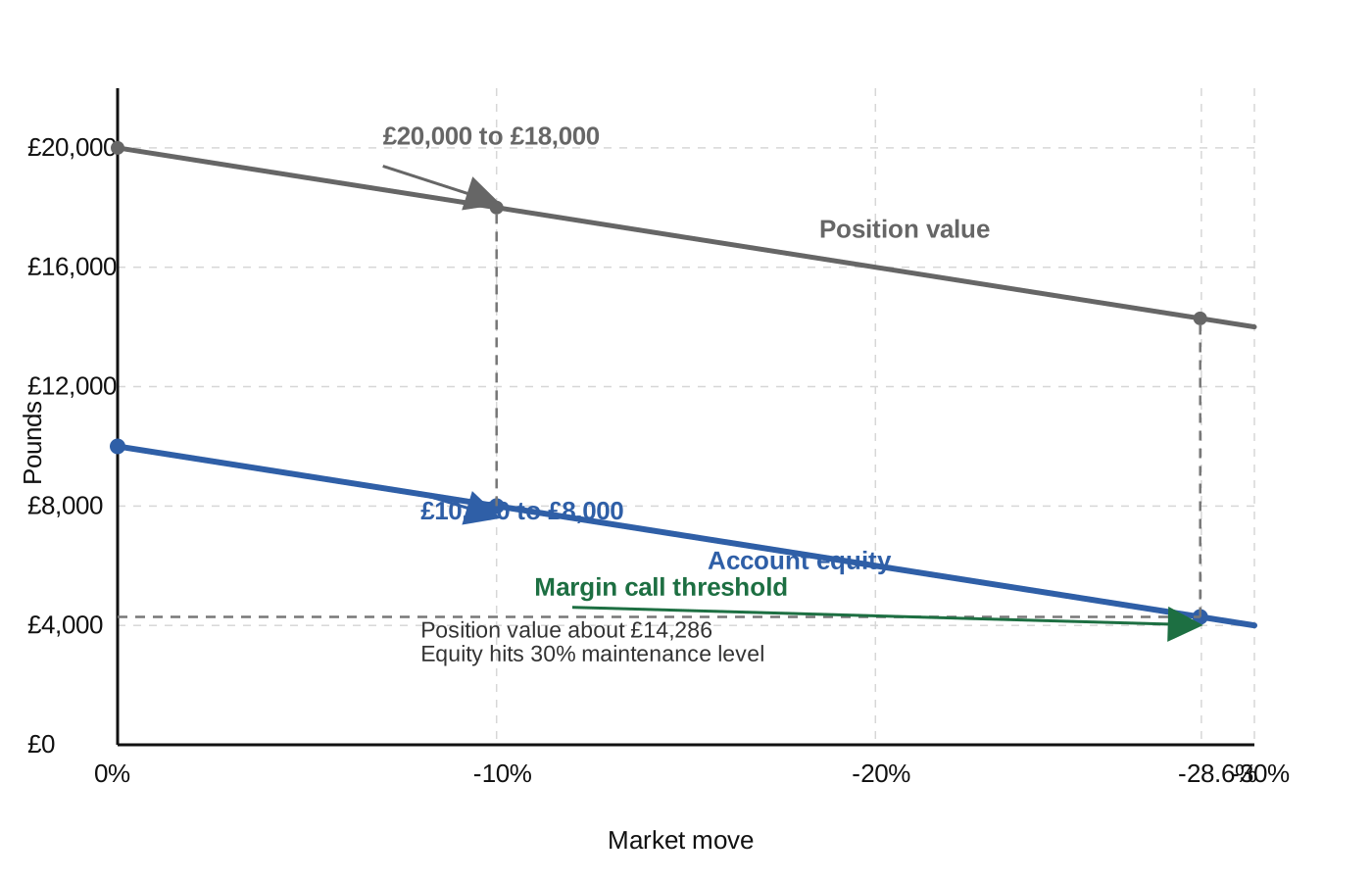
Suppose you buy £20,000 of shares using £10,000 of your own cash and £10,000 borrowed from the broker. Your equity at the start is £10,000.
If the shares fall by 10%, the position value drops to £18,000. The loan is still about £10,000, so your equity falls to £8,000. The position is down 10%, but your equity is down 20% before interest. That is leverage at work.
After opening the trade, the account must still satisfy maintenance margin. For long securities positions, FINRA states a general minimum of 25% of current market value, but firms often use stricter house requirements such as 30% to 40% or higher. A breach can happen in more than one way. You might open too large a position, suffer a market loss, or find that the firm has increased the required maintenance percentage.
That last point is easy to miss. Losses can accelerate through two channels at once: falling prices reduce equity, and rising margin requirements can increase the amount of equity needed to keep the position open.
Using the same £20,000 shares example, assume a 30% house maintenance requirement.
If the shares fall by 25%, the position value becomes £15,000. With a loan of about £10,000, equity is £5,000. Equity as a percentage of market value is 33.3%. That is still above 30%, but only just.
To find the maintenance breach point:
- Equity = Market value - £10,000
- Required equity = 30% of market value
So:
- Market value - 10,000 = 0.30 × Market value
- 0.70 × Market value = 10,000
- Market value = £14,285.71
So the breach begins once the position value falls below about £14,285.71, which is a fall of about 28.6% from the original £20,000.
If the shares fall to £14,000, equity is £4,000 while required equity at 30% is £4,200. That creates a deficiency. At that point the investor may need to deposit cash or eligible securities, or the broker may liquidate assets. If the market keeps falling, the deficiency widens quickly. If interest has accrued, true equity is slightly lower than the simplified example suggests.
A margin call does not mean you control the timetable. FINRA and the SEC note that firms do not have to wait for the client before selling securities, and may choose which assets to sell. The operational danger is that decisions can shift from the trader to the broker very quickly.
Futures work differently in day-to-day operations. The trader posts initial margin to open the contract, but this is not a loan in the stock-margin sense. It is collateral supporting the obligation. Gains and losses are then settled through daily variation margin. If losses push the account to or below maintenance margin, funds must be restored, commonly back to the initial margin level.
Consider a futures-style example:
- Notional exposure = £100,000
- Initial margin = £8,000
- Maintenance margin = £6,500
If the underlying falls by 3% in a day, the contract loss is £3,000. That amount is taken in cash through variation margin, leaving the account balance at £5,000. The account is now below maintenance. To restore it back to the initial margin level in this example, the trader would need to add £3,000. If funds are not posted promptly, the broker can close the futures position.
So although both shares on margin and futures can lead to forced liquidation, the pressure shows up differently. In a stock margin account, there is a broker loan and interest on that loan. In futures, the main immediate pressure comes from daily cash settlement and top-ups after losses.
CFDs also use margin as collateral for leveraged exposure rather than ownership of the underlying asset. Providers apply close-out rules, and for retail clients ESMA’s product intervention framework states that the margin close-out rule is applied on an account basis at 50% of the total initial margin protection required for all open CFDs. Even so, operational details can vary by provider and jurisdiction, so the safest broad point is the mechanical one: leveraged exposure plus collateral-based margining can lead to provider-led close-out when equity falls too far.
Leveraged ETFs are different again. An investor may buy them outright in a cash account, so there may be no borrowing in the account at all. But leverage still exists, only this time it sits inside the fund. The SEC warns that these products usually reset exposure daily, and returns over longer periods can differ significantly from the stated daily multiple. In volatile markets, losses can therefore be unexpectedly large even when the underlying index is flat or up over the full holding period.
This is why margin and leverage should be treated as a risk control loop, not just a way to increase buying power. First, define your gross exposure, not just your cash outlay. Then compare actual equity with the relevant initial or maintenance requirement. Next, estimate how much equity would be lost after an adverse move. Finally, decide in advance what happens if prices fall or margin conditions tighten.
A practical pre-trade routine is to estimate the equity hit from a 5%, 10% and 20% adverse move, confirm the maintenance threshold, include borrowing costs where relevant, and keep a cash buffer above maintenance rather than operating at the minimum.
The key lesson is mechanical rather than dramatic. Margin problems become hardest to solve when action is delayed until the account is already close to liquidation. By that stage, choices may narrow, the broker or provider may take control of the process, and stressed market prices can make outcomes worse.
Leverage makes a small adverse move in the underlying asset produce a larger percentage loss in account equity.
In securities margin accounts, borrowing costs such as interest can worsen outcomes over time.
Maintenance breaches can be caused by market losses, over-sized positions, or firms raising house margin requirements.
Brokers or providers may liquidate positions without waiting for the client to act, and may choose which assets to sell or close.
In futures, daily variation margin can create immediate cash demands even when the contract has not been closed.
CFD close-out mechanics and thresholds vary by provider and jurisdiction, even though the broad collateral-based logic is similar.
Leveraged ETFs can produce longer-period returns that differ significantly from their stated daily multiple, especially in volatile markets.
Verified callouts
Leverage can double the equity hit from a modest market move
In a simple 2:1 stock margin example, a 10% fall in the asset produces about a 20% loss in the investor’s equity before interest and fees. The move in the position and the move in equity are not the same thing.
Initial margin and maintenance margin are different checks
Initial margin is what you need to open the position. Maintenance margin is the ongoing threshold you must keep afterwards. Falling below maintenance can trigger a demand for more funds, position reduction, or liquidation.
Forced liquidation can happen before you are ready
FINRA and the SEC both warn that firms do not have to wait for a client before selling securities in a margin account, and the firm may decide which assets to sell. Similar practical risk exists in futures and CFDs when collateral falls too low.
Update log
- SEC, Margin: Borrowing Money to Pay for Stocks
- FINRA, Know What Triggers a Margin Call
- FINRA, Brokerage Accounts
- Fidelity, Margin loans and rates
- Investor.gov / SEC, Updated Investor Bulletin: Leveraged and Inverse ETFs
- CME Group, Performance Bonds/Margins FAQ
- CFTC, Futures Glossary
- CME Group, Margin: Know What’s Needed
- ESMA, CFD product intervention summary