

Trade construction and management rules
Overview
Constructing and managing an options trade is mainly a sequencing problem. A useful order is to define the payoff and operational obligations first, then choose expiry and strikes, then write the entry and exit rules before placing the trade, and finally manage the position by following those rules rather than improvising.
For listed options, the mechanics matter as much as the chart. Exercise, assignment, settlement style, contract size, and expiry processing can change the outcome even when the market view is unchanged.
A practical construction process usually balances several trade offs. Shorter expiries generally have faster time decay but less time to be right and sharper gamma risk near expiry. Longer expiries usually give more time and smoother daily price behaviour, but they cost more in premium and can tie up risk for longer. Strikes closer to the underlying price tend to be more sensitive and carry higher assignment exposure if sold, while strikes placed further away reduce premium and the probability of finishing in the money but may improve staying power.
Liquidity and bid ask spread quality also matter because they directly affect entry cost, exit cost, and the reliability of management rules. Rule based management means deciding in advance what will trigger four possible actions: exit for profit, exit for loss, adjust, or do nothing. Do nothing is valid when the original setup, risk cap, and time horizon remain intact and no predefined trigger has fired.
Operationally, listed equity and ETF options in the US are commonly physically settled and American style, which means a short option can be assigned before expiry. By contrast, many index options are cash settled and European style, so they typically remove early assignment risk and settle to cash rather than stock delivery. Exact product terms vary by venue and product, so any claim about exercise style or settlement should be checked against the contract specifications for that product.
Key definitions for trade construction and management
Step by step walkthrough
The trade management loop
Once the trade is open, the goal is not to be inventive. The goal is to check the setup, compare the live position with the plan, and act only when a predefined trigger has fired.
This matters most in multi leg positions, where unnecessary adjustments can add costs, create rule drift, and change the risk profile without a clear reason.
Worked examples
These examples are not universal templates. They show how a written plan can connect product mechanics, sizing, exit rules, and assignment or settlement outcomes.
Assume a stock price of $52 and a listed stock option with a contract size of 100 shares. The trade is to sell 1 put with a $50 strike and 30 days to expiry for a premium of $1.20 per share, or $120 before fees. The trade accepts the possibility of owning shares, and the gross assignment obligation is to buy 100 shares at $50, or $5,000 if assigned.
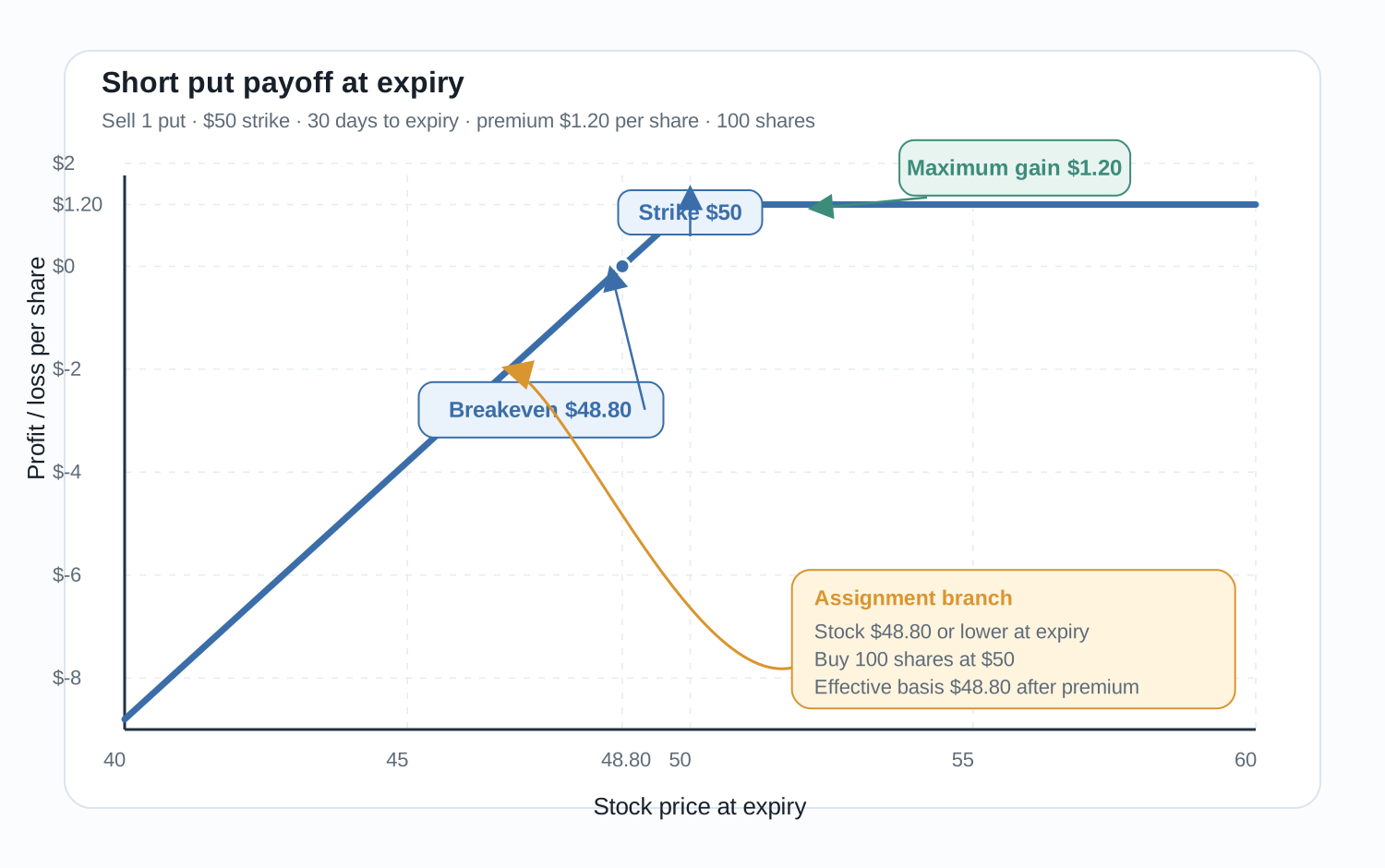
The entry plan is mechanical. Enter only with a limit order near the mid price. Enter only if the bid ask spread is acceptable for the series. Enter only if buying 100 shares at $50 is acceptable in cash and risk terms. Set a profit target to buy back the put if 70% of the premium is captured, which would be around $0.36. Set a time exit to close with 5 trading days left if the put is still open and assignment is not wanted into expiry. Set a loss and adjustment rule that if the stock falls and the original willingness to own at $50 no longer holds, the put is closed rather than justified with a new thesis.
One management path is a winner. After 12 days, the stock is $55 and the put trades at $0.30. The position has captured $0.90 of the initial $1.20 premium, or 75%. The profit target has fired, so the rule says buy to close and remove assignment risk.
Another path is hold. After 12 days, the stock is $51.40 and the put trades at $0.85. No profit target, no loss trigger, and no time exit has fired. The correct action is no action.
The assignment branch matters near expiry. If the stock is $48.80 and the put remains open, assignment means the seller must buy 100 shares at $50. Ignoring fees, the effective share basis is $48.80 after subtracting the $1.20 premium received. The trade has now converted from a short option into a long stock position acquired through assignment, which is a new operational state requiring capital and subsequent stock management.
| Measure | Basis | Value |
|---|---|---|
| Stock price at entry | Stated | $52.00 |
| Short put strike | Stated | $50.00 |
| Premium per share | Stated | $1.20 |
| Premium received | 1.20 times 100 | $120.00 |
| Gross assignment obligation | 100 shares at 50 | $5,000.00 |
| Profit target buy-back price | About 70% of premium captured | $0.36 |
| Winner path: stock after 12 days | Stated | $55.00 |
| Winner path: put price after 12 days | Stated | $0.30 |
| Winner path: premium captured | 1.20 minus 0.30 | $0.90 |
| Hold path: stock after 12 days | Stated | $51.40 |
| Hold path: put price after 12 days | Stated | $0.85 |
| Assignment path: stock price | Stated | $48.80 |
| Assignment path: effective share basis | 50.00 minus 1.20 premium | $48.80 |
| Premium received | $120.00 | |
Assume an SPX index option that is European exercise and cash settled. The trade is to buy 1 5000 put and sell 1 4900 put in the same expiry for a net debit of $20.00, or $2,000 per spread on a 100 multiplier. The maximum value at expiry is 100 index points, or $10,000. The maximum loss is the initial debit, $2,000. The maximum profit is $8,000 before fees.
The entry plan is again rule based. Enter only if the spread market is liquid enough to price the package sensibly. Set a profit target to close if the spread reaches $60.00, locking in $4,000 of value on a $2,000 cost basis. Set a loss rule to close if the spread falls to $10.00 and the original bearish thesis is invalidated. Set a time rule so that if neither trigger fires by the planned final review date, the trade is either held into expiry by prior design or closed to remove settlement uncertainty. Because SPX is European style, there is no early assignment risk while the trade is open.
At expiry, the outcome is cash based. If the final settlement value is 4875, the long 5000 put is worth 125 points and the short 4900 put is worth 25 points, so the spread settles at 100 points, its maximum. If final settlement is 4960, the spread settles at 40 points. If final settlement is above 5000, both legs expire worthless and the loss is the original debit. Settlement is in cash, not by delivering or receiving shares.
| Measure | Basis | Value |
|---|---|---|
| Net debit per spread | Stated | $20.00 |
| Net debit cash cost | 20.00 times 100 multiplier | $2,000.00 |
| Maximum value at expiry | 100 index points | $10,000.00 |
| Maximum loss | Initial debit | $2,000.00 |
| Maximum profit | 10,000 minus 2,000 | $8,000.00 |
| Profit target spread price | Stated | $60.00 |
| Profit target value | 4,000 of value on a 2,000 cost basis | $4,000.00 |
| Loss rule spread price | Stated | $10.00 |
| Expiry 4875: long 5000 put value | 125 points | 125 |
| Expiry 4875: short 4900 put value | 25 points | 25 |
| Expiry 4875: spread settles | 125 minus 25 | 100 |
| Expiry 4960: spread settles | Stated | 40 |
| Maximum profit | $8,000.00 | |
Checklists
A checklist helps preserve the sequence of decisions and reduces the temptation to improvise once the trade is live.
Pre trade construction checklist
Open position management checklist
Glossary
- Assignment
Notification to the seller of an option that the contract’s obligations must be fulfilled. For equity calls this means selling shares at the strike, and for equity puts it means buying shares at the strike.
- Exercise
Use of the option holder’s right under the contract. Whether and when this can happen depends on the contract’s exercise style.
- American style
Can generally be exercised before expiry. Common for many listed stock and ETF options in the US.
- European style
Can generally be exercised only at expiry. Common for many cash settled index options such as SPX.
- Physical settlement
Settlement by delivery of the underlying shares or securities rather than cash only.
- Cash settlement
Settlement by a cash amount based on the difference between strike and settlement value, rather than delivery of shares.
- Closing purchase / closing sale
Transactions used to reduce or eliminate an existing short or long options position.
- Exercise by exception
OCC’s administrative process for automatically exercising certain expiring in the money options absent contrary instructions. Thresholds vary by product and rules.
Verified callouts
Strike and expiry choices alter both market risk and operational risk
Shorter expiries usually increase the speed at which option value changes with time, while nearer strikes tend to increase price sensitivity and the chance that a sold option finishes in the money. For physically settled equity options, sold strikes that move in the money also increase the practical relevance of assignment planning, because short positions can be assigned before expiry.
An option trade can end in stock delivery or cash settlement
Exercise and assignment are formal contract events processed through OCC and brokerage allocation procedures, not merely a price chart crossing a strike. For equity options this can create a stock purchase or stock sale obligation, while many index options instead settle to cash and avoid share delivery altogether.
No action is a real management choice when the rule set says hold
If no preset profit, loss, time, or adjustment trigger has fired, holding the position unchanged is a valid rule based outcome. This matters because changing a trade without a predefined reason can distort the original risk assumptions and turn management into improvisation.
Internal links
Definitions
- Option exercise
- Option assignment
- Physical settlement
- Cash settlement
- American style options
- European style options
- In the money, at the money, out of the money
- Expiry and last trading day
- Contract multiplier
- Closing purchase and closing sale
- Exercise by exception
- Ex dividend assignment risk
- Vertical spread
- Short put
- Defined risk versus undefined risk
- Liquidity and bid ask spread
- Rolling an options position
- Position sizing for options
High level comparison: construction choices and their consequences
The central comparison in options trade construction is not simply bullish versus bearish. It is defined risk versus assignment exposure, speed versus staying power, and convenience versus operational complexity.
A physically settled equity option and a cash settled index option can express a similar market view, but they do not behave the same operationally. Equity and ETF options are commonly American style and physically settled, so short positions can bring early assignment risk and possible stock delivery. Many index options are European style and cash settled, so they typically remove early assignment risk and resolve to a cash debit or credit instead.
Shorter expiries usually offer faster time decay but demand more attention as expiry nears. Longer expiries usually allow more time for the thesis to work but can cost more in premium and keep capital tied up for longer. Strikes closer to spot increase sensitivity and, if sold, increase the chance that assignment planning becomes relevant. Strikes further from spot may improve staying power, but they do not remove risk.
The practical lesson is that trade construction should compare market payoff and operational consequences at the same time. A trade that looks attractive on a payoff diagram may still be unsuitable if the settlement style, assignment exposure, liquidity, or contract size does not fit the plan.
Cash settlement versus physical settlement
Settlement style changes the management plan. With physical settlement, the key question is whether delivery or purchase of 100 shares per contract is acceptable if assignment occurs. With cash settlement, the key question is whether the account is prepared for the cash debit or credit based on the settlement value.
This distinction becomes especially important when comparing equity options with many index options. A short equity option can become a stock purchase or stock sale obligation. A cash settled index option does not require share delivery, even if the position finishes in the money.
Settlement style should therefore be checked before the trade is entered, not after. It affects sizing, assignment planning, exit rules, and the meaning of expiry.
Sources
- Characteristics and Risks of Standardized Options
- Options
- Trading Options: Understanding Assignment
- Options Allocation of Exercise Assignment Notices
- Order Types
- Exchange Traded Stock / ETP Options
- Index Options Benefits: Cash Settlement
- S&P 500 Index Options product page
- S&P 500 Index Options Product Specifications
- SPX Fact Sheet
- Investor Bulletin: An Introduction to Options
- Exercise by Exception