

Options across securities
Overview
This guide explains how listed options work across three US market underlyings: individual equities and ETFs, equity indices, and futures. The aim is simple: understand what the contract really controls before you trade it.
Across these products, the main differences are operational rather than cosmetic. You need to know what is delivered or settled, the multiplier and quoting convention, the trading hours and last trading day, the clearing and margin framework, and the market structure that shapes liquidity.
That sequence matters. If you start with the underlying and the contract specification, the later questions about exercise, assignment, settlement, margin and execution become much easier to handle in practice.
Key definitions
The underlying is the instrument the option references. The deliverable is what you receive or owe if the option is exercised or assigned.
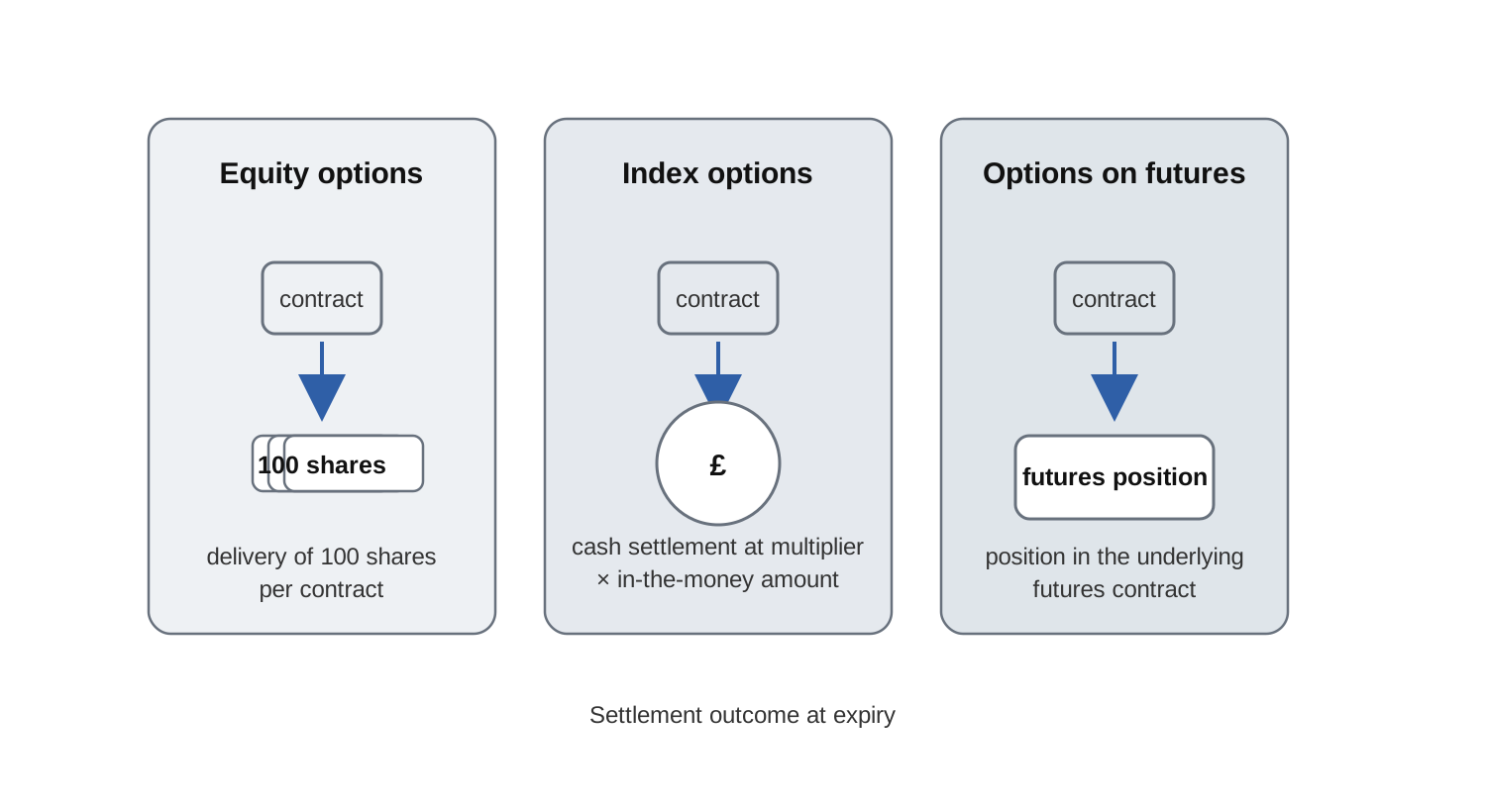
For equity options, exercise typically results in delivery of shares. For most broad-based index options, settlement is in cash rather than shares. For options on futures, exercise results in a position in the underlying futures contract.
Step by step walkthrough
The cross security decision loop
A useful way to compare option products is to run the same decision loop each time: identify the underlying category, read the contract specification, check settlement and exercise mechanics, confirm trading hours and last trading day, then review margin and liquidity.
Running that loop in the same order helps prevent category mistakes, such as assuming all options settle into stock, assuming all products trade only during the US cash session, or overlooking that a futures option can turn into an actively margined futures position.
Worked examples
The examples below keep the arithmetic simple and focus on what changes across products: what the premium really costs, what happens at expiry, and what position or settlement appears afterwards.
Assume the underlying is XYZ Corp common stock. You buy 1 XYZ 50 call expiring on Friday. The contract multiplier is 100 shares and the premium is 2.00 dollars per share, so the total premium paid is 200 dollars plus fees. The option is American style and physically settled, the regular session ends at 16:00 ET, and the exercise cutoff is 17:30 ET.
If XYZ closes at 51.20 on expiration Friday, the call is 1.20 in the money. OCC exercise by exception applies and, absent contrary instructions, the contract is automatically exercised. You buy 100 shares at 50.00, paying 5,000 dollars on exercise date Friday, and the shares settle to your account on T+1, which is Monday if it is a business day. Ignoring costs, the option’s intrinsic value is 1.20 times 100, or 120 dollars. Against the 200 dollar premium, that is a net loss of 80 dollars. From Monday onward, the long shares carry market risk.
If XYZ closes at 49.90, the option expires worthless. No exercise occurs, no shares move, and the premium loss is 200 dollars.
| Measure | Basis | Value |
|---|---|---|
| Premium per share | Stated | $2.00 |
| Total premium paid | 2.00 times 100 | $200.00 |
| Close at 51.20 | In the money by | $1.20 |
| Strike cost | 100 shares at 50.00 | $5,000.00 |
| Intrinsic value | 1.20 times 100 | $120.00 |
| Net result versus premium | 120 minus 200 | $-80.00 |
| Close at 49.90 | Out of the money, expires | $0.00 |
| Premium loss at 49.90 close | Stated | $200.00 |
| Net result versus premium | $-80.00 | |
Assume the underlying is the E-mini S&P 500 future, with a multiplier of 50 dollars per index point. You buy 1 ES European-style Tuesday weekly 6000 call and pay a premium of 10.00 index points. That means the premium paid is 10.00 times 50, or 500 dollars. Trading takes place on Globex from Sunday 18:00 ET to Friday 17:00 ET with a daily maintenance break.
At 16:00 ET on expiry Tuesday, suppose the ES settlement reference is 6020. The option is 20 points in the money. For these European-style ES weeklies, exercise results in a position in the nearest expiring quarterly E-mini S&P 500 future as of option expiration, and contrarian instructions are generally not allowed for these series. You become long 1 ES future at the strike of 6000.
From that point, the futures position is processed through CME’s cycle for the session and then margined and marked to market like any other futures position. The key point is that expiry does not simply create a cash settlement amount. It creates a futures position with ongoing variation margin.
| Measure | Basis | Value |
|---|---|---|
| Premium per index point | Stated | $10.00 |
| Total premium paid | 10.00 times 50 | $500.00 |
| Multiplier | Dollars per index point | 50 |
| Strike | ES call | 6,000 |
| Settlement reference at expiry | Stated | 6,020 |
| In-the-money points | 6020 minus 6000 | 20 |
| In-the-money points | 20 | |
Checklists
Use these checklists to slow down the process before placing a trade and again before expiry. Most avoidable mistakes come from skipping contract details, settlement style, or cut-off times.
Pre trade cross security checklist
Expiry, margin, and settlement readiness checklist
Glossary
- American style
An option that can be exercised on any business day up to and including expiration.
- European style
An option that can be exercised only on the expiration date.
- Exercise by exception
The OCC process that automatically exercises expiring options at or above a defined threshold unless instructed otherwise.
- Multiplier
The factor used to scale a quoted premium or index point amount into the contract’s cash value. Typical US equity and index options use 100, while futures options inherit the futures multiplier.
- OPRA
The securities information processor that consolidates US listed options quotes and trades across exchanges for the NBBO.
- SPAN
CME’s portfolio margin framework for futures and options on futures.
- STANS
OCC’s risk-based margin methodology for clearing members.
Verified callouts
Settlement style depends on the underlying category
Most US equity options are American style and physically settled in 100-share units when exercised. Broad-based index options such as SPX and RUT are cash settled and generally European style, while options on futures at CME exercise into a futures position according to the product specification.
Multipliers change the real cash exposure
Equity and index options commonly use a 100 multiplier, including scaled index products such as XSP. ES futures are 50 dollars per point and MES are 5 dollars per point, and options on those products inherit that notional structure.
Trading hours and last trading times are product specific
US equity options trade in the regular 09:30 to 16:00 ET session, while selected Cboe index products also trade in Global Trading Hours. CME equity index futures options trade from Sunday evening to Friday with a daily maintenance break, and last trading times depend on the specific product and series.
Internal links
Definitions
- American style option
- European style option
- Cash settlement vs physical delivery
- Contract multiplier and tick size
- Exercise by exception and OCC cutoff
- A.M. vs P.M. settlement for index options
- Portfolio margin vs strategy-based margin
- SPAN and STANS margin methodologies
- OPRA and NBBO for options
- Futures-style vs premium-style option margining
High level comparison across securities
Equity and ETF options are usually the most familiar starting point. They are generally American style, physically settled into shares, quoted in dollars per share, and commonly use a 100 multiplier. If exercised or assigned, they create a stock position and related settlement activity.
Index options differ because the deliverable is usually cash rather than shares. Many broad-based index products, including many SPX series, are European style, which removes early exercise. Settlement can depend on either an opening or closing index calculation depending on the series, so the timing of the settlement value matters.
Futures options differ again because exercise produces a futures position. That means expiry is not the end of market exposure. Once exercised, the position continues as a futures contract and is then margined and marked to market through CME Clearing.
Cash settlement versus physical delivery
Cash settlement means the option resolves to a cash credit or debit rather than a transfer of the underlying instrument. This is the standard pattern for many broad-based index options.
Physical delivery in this context usually means equity shares are delivered on exercise. A standard US equity option contract generally controls 100 shares unless adjusted for corporate actions.
Options on futures are a third case. They do not settle into shares or a simple cash amount in the same way. Instead, exercise creates a position in the specified futures contract, after which futures margining and daily variation flows apply.
Sources
- Characteristics and Risks of Standardized Options
- Equity Options Product Specifications
- Rules including Rule 805 exercise by exception
- Rule 4210 Margin Requirements and Interpretations
- Information Notice on Exercise Cutoff
- US Options Hours and Holidays
- SPX Options Product Specifications and Fact Sheet
- XSP Mini-SPX materials
- Russell 2000 Index Options specifications
- IR statement confirming SPX exclusivity
- SPAN methodology and margin model
- Holiday and Trading Hours
- Options on Micro E-mini S&P 500 and Nasdaq-100 futures FAQs and fact card
- E-mini S&P 500 European-style Tuesday and Thursday Options FAQs
- Official site describing OPRA consolidated feed
- Equity Options specifications including penny increments and baseline margin formula references